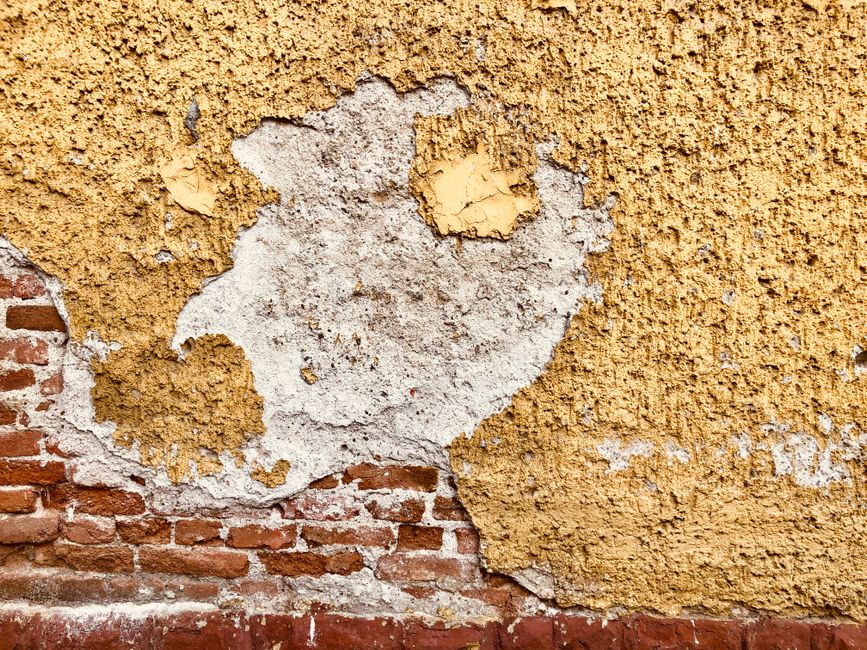
From the street, the villa looks immaculate. Fresh render, clean lines, the kind of finish that says the owner cares. Step closer to the north-facing wall and there it is — a pale, chalky bloom creeping across the lower course, faint but unmistakable. That is efflorescence, and in Larnaca it is almost never cosmetic. It is dissolved salt left behind by water moving through your masonry or concrete, and it is the building telling you, quietly, that something behind the paint is already wrong.
Key takeaways
The short version, before we get into the diagnosis.
- Efflorescence is a symptom of water movement, not a surface stain to be scrubbed off
- Larnaca's coastal air, driving rain and fast-built concrete make it a regional favourite
- Repainting over it traps moisture and accelerates the underlying failure
- The correct response is a proper diagnosis of the water path, then waterproofing the right area
- Our work across Larnaca is backed by a 10-year workmanship guarantee and an insurer-ready report
What that white bloom actually is
Efflorescence is what happens when water finds soluble salts inside your building materials — cement, mortar, concrete, block, plaster — carries them to the surface, then evaporates and leaves the salt behind. The white crust is the residue of a journey. Which means the interesting question is never what is on the wall. It is where did the water come from, and where is it still going.
Owners in Larnaca often assume it is a surface issue because it looks like one. A powdery patch. A dusty streak under a window. A halo around a downpipe. Wipe it, repaint, move on. Six months later the same patch is back, slightly larger, and the render around it sounds hollow when you tap it.
That is not bad luck. That is the water route repeating itself.
Why Larnaca walls do this more than most
A few things stack up on this coast, and they stack up against your building.
First, the air itself. Larnaca sits with the sea on one side and open agricultural land on the other, and the prevailing wind carries salt inland further than owners expect. That salt lands on facades, dissolves in rain and dew, and gets drawn into any porous surface it can find. Coastal properties are not the only ones affected — inland villas around Aradippou, Livadia and Oroklini see it too.
Second, the way things are built here. A great many Cyprus buildings, including expensive ones, were put up quickly on bare concrete and block with thin external render and minimal external waterproofing. The assumption was that the sun does most of the drying work. It does, until it doesn't.
Third, the rain pattern. Larnaca can go months looking bone-dry, then take a full winter's worth of water in a few November nights. Walls that were quietly absorbing humidity all summer suddenly get flushed, and every weak joint, cold bridge and hairline crack becomes a route. The salt bloom that appears in December was being written months earlier.
Fourth — and this is the one owners resist hearing — the habit of we'll deal with it next year. Efflorescence is patient. It will wait. It will also compound. If you want a longer read on that pattern across the island, we wrote about it here: Damp and Leaks in Cyprus Villas: What's Really Going On.
What it turns into if you leave it
This is the part worth being honest about.
Efflorescence on its own does not eat your building. The water making the efflorescence does. Left running for a year or two, the same route that deposits salt on the surface will soften the render behind it, degrade the bond between coats, and begin to corrode any steel reinforcement the water reaches. Concrete with rusting rebar swells, cracks and spalls — and once you can see that from the outside, you are no longer in the world of waterproofing. You are in the world of structural repair.
Inside, the same water shows up as cold patches, blistering paint, and eventually mould in the corners of rooms that back onto the affected wall. Owners often treat the interior symptom first, which is understandable and completely useless. The mould is downstream. If it is showing up on your Larnaca interiors as well, this is worth reading: Mould on Walls Larnaca: What It Really Means for Your Property.
And then there is the finish itself. Marble skirtings pit. Timber floors near the wall cup and lift. Expensive plaster details lose their edges. None of these are things you notice on day one. All of them are things you notice on the day you try to sell, or the day a serious tenant walks through with a surveyor.
Reading the wall: signs, causes, and what we actually inspect
Efflorescence is a language. Where the salt appears tells you where the water is coming in.
| Warning sign on the wall | Likely cause | Area we inspect |
|---|---|---|
| White bloom low on ground-floor walls, worst after rain | Rising damp or failed sub-structure waterproofing | Ground-level walls, basements, sub-structure |
| Halo around a specific window or door | Failed sill, lintel or perimeter seal, driving rain | Facade, openings and surrounding render |
| Streaks running down from a parapet or roofline | Compromised roof or parapet detail above | Roof, flat roof, parapet flashings |
| Patchy bloom on a terrace or veranda wall | Failed terrace or balcony waterproofing shedding water into the wall below | Terrace, veranda, balcony deck and upstands |
| Salt lines along a garden or retaining wall | Water tracking laterally from planters or landscaping | Planters, retaining walls, ground-level joints |
| Bloom on internal wall of a wet room | Failed wet-room tanking behind tile or stone | Wet room substrate and perimeter |
That table is not decoration. It is roughly the first fifteen minutes of a site visit — matching pattern to probable source, then confirming with instruments rather than assumptions.
While we are on the subject of upstairs sources, salt bloom on an upper-storey ceiling or the top of an interior wall is often a roof story rather than a wall story. Two useful reads for that: Roof Leak Repair Larnaca: Why the Salt Air Wins and Ceiling Water Stains Larnaca: What's Failing Above You.
Considering a site visit?
If the bloom on your Larnaca property is spreading, or coming back after a repaint, the diagnosis is the fix. Get an instant estimate, or book a site visit and we will read the building in person.
How WATERPROOFED.cy resolves it — properly, once
We do not sell you a coating and hope. That is not the business we are in.
We diagnose the real source. Every job starts with a proper survey of the affected area — external and internal, with moisture readings, thermal imaging where appropriate, and a careful look at the details owners tend to skip: parapet junctions, sill undersides, expansion joints, ground levels against the wall, downpipe terminations, terrace upstands. Efflorescence is a downstream clue. We work upstream until the water path is understood, not guessed.
We select the best-suited approach for that specific area. A ground-level rising-damp problem in an Oroklini villa and a driving-rain facade problem on a Larnaca marina apartment building are the same only in that both produce white bloom. The correct waterproofing response is different for each, and it is our job to specify what actually belongs on your building — not what happens to be in the van.
We write a proper specification and a documented report. Every defect we find is recorded, photographed and written up in a form your insurer, your surveyor and your legal team can use. If there is a construction defect, an original workmanship failure, or a shared-wall issue in a complex, the paperwork exists.
We oversee vetted contractors on site. Waterproofing lives or dies at the details, and details are where cheap crews cut corners. We supervise the works to the specification, so the wall you own in ten years is the wall we signed off on this year.
Every job carries our 10-year workmanship guarantee. Ten years, in writing, backed by a firm whose reputation is the entire business.
We work on villas, mansions, apartment buildings and complexes across Larnaca — town, coast and villages — and across Limassol, Paphos, Nicosia, Ayia Napa and Polis. Serious buildings, done properly.
Why the cosmetic route always loses
A quick word on the temptation to handle this yourself.
The wire brush and a fresh coat of masonry paint feel productive. They feel like action. They are, in fact, the exact intervention that lets the underlying problem run for another eighteen months undisturbed — because now you cannot see it, and you are less likely to call anyone. When it does come back, it comes back through your new paint, and the paint itself becomes part of the failure.
If you catch efflorescence early, on a wall that has not yet been repeatedly overcoated, the diagnostic route is genuinely faster and cleaner than most owners expect. It is the buildings that have been patched three times that become expensive to unwind.
If you are also noticing drips, ceiling stains or damp corners inside, treat it as one problem: Water Leak Repair Larnaca: What the Drip Is Telling You.
Frequently asked questions
Is efflorescence on my Larnaca wall dangerous?
The salt itself is not toxic, but what it represents is serious. It means water is moving through the wall, dissolving minerals as it travels and depositing them on the surface. Left alone, that same water route corrodes reinforcement, degrades render and eventually reaches interior finishes.
Can I just scrub the salt off and repaint?
You can, and it will look clean for a few months. Then it returns, often worse, because the water path behind the wall has not changed. Painting over active efflorescence also traps moisture and accelerates blistering, so the cosmetic fix becomes the next repair.
Why does this happen so often in Larnaca specifically?
Larnaca sits on the coast, which means salt-laden air, driving rain from the south and long dry spells that mask movement inside the wall. Combine that with the region's fast-built concrete and block construction, thin renders and untreated substructures, and you get a climate almost designed to produce efflorescence.
Do I need to fix efflorescence before selling or renting the property?
You should. Buyers, surveyors and serious tenants read white bloom as evidence of an unresolved damp problem — because it usually is. A documented diagnosis and a completed waterproofing works file, backed by a guarantee, protects both value and negotiation.
What area of the building do you actually inspect?
Whatever the salt is telling us to inspect. Ground-level walls point to rising damp or a failed substructure. High-level patches point to a roof, parapet or terrace above. Facade patterns point to driving rain and render failure. We diagnose the source, then treat the area properly — once.
Is the work guaranteed?
Yes. Every waterproofing job we complete in Larnaca and across Cyprus is backed by our 10-year workmanship guarantee. The specification is documented, the contractors are vetted and supervised, and the report is written in a form your insurer can use if needed.
Book the diagnosis, not another repaint
If you are seeing efflorescence on a Larnaca property you own or manage, the useful next step is not another coat of paint. It is a site visit from someone who will read the building properly and tell you where the water is actually coming from.
Book a site visit, or message us on WhatsApp for a faster reply. You can also get an instant estimate to frame the scope before we meet. Whatever the finding, the work will be specified in writing, executed by vetted contractors under our supervision, and backed by our 10-year workmanship guarantee.
One diagnosis. One correct fix. One less thing to think about for the next decade.