"There's a brown circle on my living room ceiling and it's nowhere near the bathroom. Is the pipe broken or is it the roof?"
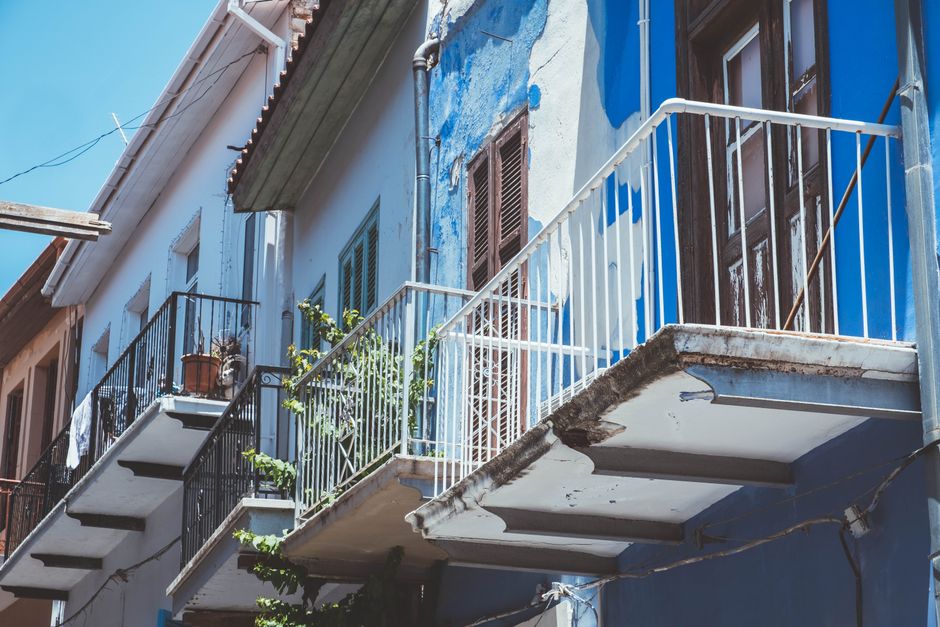
That was a Larnaca client last November, second week of rain, voice somewhere between annoyed and resigned. Honest answer: probably neither, and also possibly both. Water doesn't travel in straight lines. It travels along whatever's easiest — a rebar, a conduit, the underside of a slab — and then it drops where gravity finally gives up on it. The stain is the exit. The entry is usually a few metres away, sometimes a floor up, occasionally on the other side of the building entirely.
Welcome to water leak repair in Larnaca, where the question is almost never "is there a leak" and almost always "where on earth is it actually coming in."
Why Larnaca, specifically, eats buildings
Larnaca has a particular cocktail. Salt air off the bay. A long, brutal dry season where everything bakes and shrinks and opens up hairline cracks you can't see. Then the November and January rains arrive in a hurry — not a soft drizzle, a proper sideways shove of water — and every one of those summer cracks introduces itself.
Add the building stock. A lot of Larnaca's apartment blocks went up fast in the 80s and 90s, with flat roofs designed for a climate that no longer quite exists. Newer villas around Oroklini, Pyla, Livadia — beautiful exposed concrete, big terraces, ground-level patios that drain (in theory) towards the garden. In practice, they drain towards your basement.
And then there's the airport approach. I mention it because half my Larnaca clients are owners who live abroad and visit twice a year. The building has been quietly leaking since March. They land in October. They open the apartment. Something smells. That smell is months of damp talking.
What the stain actually means
A ceiling stain is a receipt. It's the building telling you, with admirable patience, that water has been doing something it shouldn't for weeks — possibly months — before it had enough volume to show through plaster and paint.
By the time you can see it, the concrete above has likely been wet for a while. Rebar starts to do what rebar does in a marine climate near the sea: it rusts, it expands, it pushes the concrete outwards from the inside. That's the brown rust line you sometimes see running along the underside of a balcony soffit. Not a stain. A slow-motion structural problem.
The usual suspects in Larnaca, roughly in order of how often we find them:
- A flat roof whose original waterproofing layer gave up around year fifteen and nobody noticed because the parapet hid the pooling.
- A terrace or veranda where the tiles look fine but the layer underneath the tiles stopped working a long time ago.
- A planter built directly into the slab (a particular favourite of premium villa designs) that has been watering the room below for two seasons.
- A facade crack on the seaward side, where wind-driven rain gets pushed horizontally into the wall.
- A balcony drain that's blocked with eight years of dust, leaves and one very committed pigeon.
Notice what's not on that list: "a broken pipe." Pipes do leak. But in Larnaca, nine out of ten ceiling stains I get called to are envelope failures, not plumbing. Plumbers get called first anyway. I'm not bitter about it. (I'm slightly bitter about it.)
The "we'll sort it next year" tax
There's a Cyprus habit I've made peace with but still find expensive to watch. The first stain appears. It's small. Someone repaints it. Summer comes, everything dries, the repaint holds. The owner exhales. Problem solved, supposedly.
It isn't solved. It's paused.
Next winter the stain comes back bigger, because the water has been finding new routes inside the slab all year. The year after that, the plaster starts to bulge. The year after that, the rebar shows. Now you're not paying for waterproofing — you're paying for waterproofing and concrete repair and a respray of the facade and a very awkward conversation with your downstairs neighbour whose ceiling now matches yours.
Ignored leaks also do quiet damage you don't see for a while: mould behind wardrobes, swollen skirting, electrics that start tripping in damp weather, that smell I mentioned earlier that becomes the smell of the apartment. For a thorough walkthrough of how this creeps up on owners, this piece is worth your time — the quiet failures owners miss. And if it's already moved past staining into damp and mould, the Tuesday reality check covers what that actually looks like.
How we actually approach a Larnaca leak
I'll keep this honest, because I think owners deserve honesty more than they deserve a sales pitch.
We come and look. Properly. Not a five-minute glance and a confident verdict — a proper diagnosis, because guessing in this trade is how you end up redoing the job in two years. We trace where the water is entering, not just where it's exiting, which often means we're up on the roof or out on the terrace while you're showing us the stain in the bedroom. We check the obvious things — parapets, drains, expansion joints, balcony upstands, planter edges, facade cracks on the windward side. We also check the unobvious things, which is honestly where most of the answers live.
Then we write it up. A real report, with photos, in language an insurer can use and a building manager can act on. That report matters more than people realise — especially in apartment blocks where the common-area question (who pays for what) is about to come up. Methods, briefly explained for owners who want to understand the choices behind the recommendation.
We don't push one system at every building, because every building isn't the same. A flat roof in Mackenzie with a parapet detail problem is a different job from a basement in Aradippou taking water laterally from the garden. We select the approach that fits the surface, the exposure, the access and how you actually use the space — then we oversee the contractors doing the work, on site, so it gets done the way we specified rather than the way that was easiest at 3pm on a Friday.
That last part sounds small. It isn't. Most of the failed waterproofing I'm called to inspect in Larnaca didn't fail because the product was wrong. It failed because nobody watched the application. Edges weren't lapped. Upstands weren't taken high enough. The detail around the drain was, to be diplomatic, optimistic.
What to do this week
If you've got a stain, take a photo of it now, then another in three days. Movement is information. If the edge is creeping, the leak is active. If it's perfectly static and bone dry to the touch, the entry point may have closed itself temporarily — which is not the same as fixed, and the next rain will remind you.
Then — and I'd say this even if it wasn't my job — get someone qualified to look before the next proper rain. November in Larnaca has a way of arriving without warning, and once it's raining sideways, diagnosis gets harder and tempers get shorter. For the broader picture of what owners actually need from a specialist, and what actually stops the leak once we've found it, those two are honest reads.
Before the next rain
If any of this is sounding uncomfortably familiar — the stain, the smell, the suspicion that last winter wasn't a one-off — book a site visit and we'll come and look at it properly. Or message us on WhatsApp with a photo of the stain. Even from a phone picture I can usually tell you whether you've got a week or a season.