The first proper rain of the season arrived overnight, and by morning the ceiling above the stairwell had a brown ring on it that was not there in August. That is how it usually announces itself in Larnaca — quietly, while you were asleep, exposing exactly what the summer was hiding. A ceiling water stain is not a decorating problem. It is your building telling you, in the politest possible way, that water has already found a path through the structure above you, and that the path has been open for longer than you think.
Key takeaways
The short version, before we get into the detail.
- A ceiling stain in Larnaca is almost always a symptom of a failure on the roof, terrace, balcony or a pipe above — not a paint problem.
- Salt-laden coastal air and fast-built concrete shells accelerate the failures behind these stains, particularly after the first heavy autumn rain.
- Painting over the mark, or chasing it with sealant from above, hides the source and lets the slab quietly suffer.
- We diagnose where the water actually enters, document every defect for insurers, and oversee vetted contractors to resolve it once.
- Every job is backed by our 10-year workmanship guarantee, across Larnaca and island-wide.
What that stain is actually telling you
A ceiling stain is the visible end of an invisible journey. Water entered the structure somewhere — usually metres away from the mark you can see — travelled along the path of least resistance through screed, slab or services, and finally found a soft spot in the plaster to bleed through. By the time the colour shows on your ceiling, the slab above has been wet for days. Sometimes weeks.
That colour matters. A pale, tea-coloured ring tends to mean clean rainwater carrying dust and salts from the roof finish. A darker, almost rust-edged stain often points to water in contact with reinforcement steel, which is a different conversation entirely. A grey, fuzzy bloom is biological — mould has had time to set up home, which means the moisture has been there far longer than the owner usually wants to admit.
None of this is solved by paint.
Why Larnaca ceilings get marked in the first place
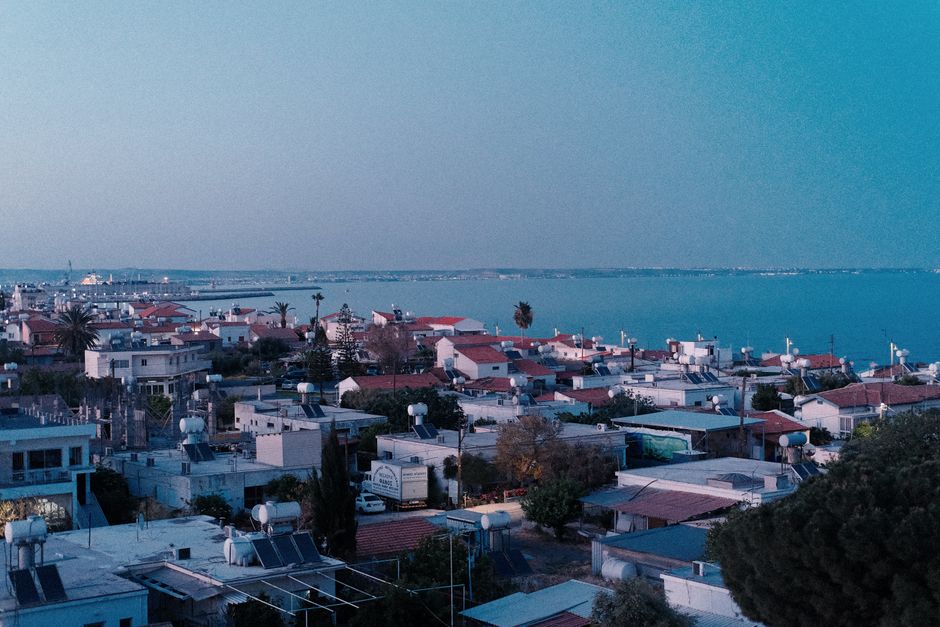
Larnaca punishes buildings in a specific way. The coast brings salt-laden air that drifts inland further than people expect, and salt is patient — it works into hairline cracks, into the edges of membranes, into the joints around rooflights and parapets, and it widens what it finds. Then summer bakes the structure for months, opening micro-fissures in screeds and exposed concrete. By October, the building is, in places, slightly more porous than it was in May.
Then the first heavy rain arrives, often all at once, and every one of those small openings is tested simultaneously.
There is also the construction culture to be honest about. A great many Larnaca buildings — apartment blocks, villas, mixed-use shells — were put up quickly, with waterproofing treated as an afterthought rather than a discipline. Flat roofs were poured and left. Terraces were tiled directly over screed with no proper tanking beneath. Parapet upstands were detailed by whoever was on site that day. The result is a generation of buildings that look fine in July and start to weep in November. We have written more broadly about this pattern in Damp and Leaks in Cyprus Villas: What's Really Going On, and it applies just as cleanly to apartment buildings and complexes.
The usual suspects above a Larnaca ceiling
When we are called to a stained ceiling in Larnaca, the source is almost always one of a handful of areas. The mark on the ceiling rarely sits directly below the entry point — water travels — so the trick is reading the building, not the stain.
| Warning sign on the ceiling | Likely source above | Area we inspect |
|---|---|---|
| Brown ring near an external wall | Failed parapet upstand, cracked render, blocked scupper | Roof perimeter, parapet detailing, drainage outlets |
| Stain under a balcony or terrace | Failed waterproofing under tiles, cracked grout, blocked floor drain | Terraces, verandas and balconies above |
| Dark patch around a light fitting | Water tracking along conduit from roof penetration | Roof penetrations, service entries, rooflights |
| Stain near a bathroom or kitchen above | Concealed plumbing leak, failed wet-room tanking | Wet rooms, pipework, slab penetrations |
| Fuzzy grey bloom in a corner | Long-standing low-level ingress, cold bridge condensation | Wall and facade junctions, insulation continuity |
| Stain that appears only after heavy rain | Roof or terrace failure, not plumbing | Roofs and flat roofs, terrace finishes |
The pattern matters because the fix depends entirely on which of these is actually happening. Treating a parapet failure as a plumbing problem, or vice versa, is how owners end up paying twice.
What it quietly turns into if you leave it
This is the part owners and building managers consistently underestimate. A ceiling stain is cosmetic for about a week. After that, it is structural.
Concrete slabs in Cyprus are reinforced with steel. Once water reaches that steel and stays there, corrosion begins, and corroded steel expands — sometimes to several times its original volume. That expansion cracks the concrete from the inside out. You will see it eventually as rust streaks bleeding through the ceiling, then as spalling where chunks of the soffit drop away. By that stage you are not repainting a ceiling; you are repairing a slab, and the conversation has become considerably more serious.
Before it gets that far, you lose other things. Insulation in the ceiling void becomes saturated and stops insulating, so cooling bills climb. Plaster debonds in sheets. Timber elements — skirtings, door frames, joinery — swell and warp. Mould establishes in cavities you cannot see, and the air in the room starts to feel heavier than it should. In rental units and complexes, tenants notice, and they tell each other.
And then there is the insurance question. Most policies in Cyprus distinguish sharply between sudden, accidental damage and gradual deterioration. A stain that has been visible for two seasons is, in the eyes of an adjuster, the latter. Documenting the defect early — properly, in writing, with photographs — is often the difference between a covered claim and a polite refusal. We cover the broader pattern of slow water damage in Water Leak Repair Larnaca: What the Drip Is Telling You, and the principle is identical here: time is not on the owner's side.
How we actually resolve it
This is where we earn our keep. A stained ceiling is a diagnostic problem before it is a repair problem, and the diagnosis is what most of the market gets wrong.
We start at the ceiling and work outward. The position, shape and colour of the stain, the orientation of the slab above, the location of penetrations, the history of the weather, the age and construction of the building — all of it goes into narrowing down where the water is entering. Then we go up. We inspect the roof, the terrace, the balcony, the parapet, the planters, the wet rooms, the service routes — whichever combination the evidence points to — and we test, rather than assume.
Once we know what is actually failing, we write a clear specification of the work required. Not a vague quotation. A specification: which area, which defects, which sequence, which standard of finish. We document every defect we find in a report that is genuinely useful to insurers and loss adjusters — photographs, locations, written findings, the lot. Owners and building managers tend to find that report alone changes the temperature of difficult conversations with insurers and committees.
Then we oversee the work. We do not hand you a piece of paper and wish you luck. We bring in vetted contractors we have worked with on serious projects, and we supervise the job from start to finish so the specification is followed exactly. The waterproofing approach itself is chosen for the specific area and the specific failure — roofs and flat roofs, terraces and balconies, parapets and upstands, wet rooms, planters, exposed concrete, basements and sub-structures all behave differently, and the right approach for one is the wrong approach for another. That choice is ours to make and to stand behind.
And we do stand behind it. Every job we specify and oversee is backed by our 10-year workmanship guarantee. The point of the guarantee is not marketing. The point is that we are confident enough in our diagnosis and our supervision to put our name on the outcome for a decade.
If you want to understand more about how the choice of approach is made for different parts of a building, our methods guide walks through the logic without the jargon.
Stop the next rain making it worse
If the stain is already there, the next rain will not be kinder. The cheapest moment to fix this is the one closest to now.
You can get an instant estimate in under a minute, or book a site visit and have us read the building in person.
Why owners in Larnaca call us specifically
There are people in Cyprus who will sell you a bucket of sealant and a ladder. We are not them. We work on buildings, complexes, villas and premium properties where the cost of getting it wrong — in finishes, in structure, in tenant relationships, in reputation — is higher than the cost of getting it right the first time.
What owners and managers tell us they value, in roughly this order: that we diagnose the real source instead of patching the symptom; that the written report is detailed enough to use with insurers without translation; that the contractors who turn up have actually been vetted and are actually supervised; that the 10-year guarantee means we are not going to disappear after handover. None of that is unusual to ask for. It is, unfortunately, unusual to receive.
We cover Larnaca, Limassol, Paphos, Nicosia, Ayia Napa and Polis — and we travel for the right project. The principles in Roof Leak Repair Larnaca: Why the Salt Air Wins and Villa Waterproofing Cyprus: What Owners Don't See apply identically to a stained ceiling in a complex off the Larnaca seafront and to one in a mansion outside Oroklini.
Frequently asked questions
Is a ceiling water stain in Larnaca always a roof leak?
No. In Larnaca it is often the roof, but balconies above, terrace upstands, planter boxes, air-conditioning condensate lines and concealed plumbing all produce the same brown ring. The mark tells you water is arriving; only a proper diagnosis tells you from where.
Can I just paint over the stain once it dries out?
You can, and it will return. Stain-blocking primer hides the evidence but does nothing to the path the water took to get there. Once the next proper rain arrives, the same ring reappears in the same place — usually larger.
How quickly should I act after the first stain appears?
Before the next rain event, ideally. A single stain means water has already reached the underside of the slab. Reinforcement corrosion and adhesion failure begin long before the ceiling looks dramatic, so the sooner the source is found, the smaller the eventual repair.
Will the report you produce be useful for an insurance claim?
Yes. We document the defects we find with photographs, location notes and a clear written specification of what failed and why. Loss adjusters and insurers can read it directly, which tends to shorten the conversation considerably.
Do you work on apartment buildings and complexes, not just villas?
We do. Buildings, complexes, villas and premium properties across Larnaca and the rest of Cyprus. Shared roofs and communal terraces are some of the most common sources of stained ceilings inside individual units.
What does the 10-year guarantee actually cover?
Our workmanship on the waterproofing scope we specify and oversee. If the area we treated fails within ten years through a fault in how it was done, we put it right. That is the point of having us write the specification and supervise the contractors ourselves.
Book the diagnosis before the next storm
A stained ceiling is the cheapest warning your building will ever give you. The expensive ones come later, and they come without warning.
Book a site visit and we will read the building properly — roof, terrace, parapets, services, the lot — and tell you exactly what is failing and exactly how we will resolve it. If you would rather start informally, message us on WhatsApp and send a photo of the stain; we can usually narrow the source down from there. Every job we take on in Larnaca is backed by our 10-year workmanship guarantee, and we would rather earn that guarantee than oversell it.
The rain is not going to wait. Neither should you.