Stripping the skirting, sanding back the blown plaster and rolling on two coats of anti-damp paint is the Limassol owner's reflex. It looks decisive. It lasts a winter, sometimes two. Then the tide mark returns — higher than before, wider than before, and now with salt crystals pushing through the new paint like frost. Rising damp is groundwater wicking up through porous masonry, and you cannot paint your way out of a hydraulic problem. The only fix that holds is diagnosing where the moisture is entering the structure and stopping it at the source.
Key takeaways
The short version, before we go deeper:
- Rising damp in Limassol is moisture travelling upward through the wall, not condensation or a paint failure.
- Anti-damp paint, fresh plaster and dehumidifiers postpone the symptom and worsen the substrate.
- Coastal salt, shallow foundations and fast-built concrete make the city particularly vulnerable.
- Ignored, it ruins plaster, skirtings, joinery, electrics, and eventually the rebar inside the concrete.
- We diagnose the real source, write an insurer-ready report, oversee vetted contractors, and back every job with a 10-year workmanship guarantee.
What rising damp actually is
Masonry is not a solid block. It is a network of tiny capillaries — pores in the render, the blockwork, the mortar, the screed. When the base of a wall sits in contact with damp ground, water climbs those capillaries the way it climbs a sugar cube dipped in coffee. It does not need a crack. It does not need a leak. It only needs a path and a source.
In a properly built wall, that path is broken. A damp-proof course, tanking at the slab edge, a well-detailed plinth — something physically interrupts the journey upward. When any of those are missing, badly installed, or punctured later by a service penetration or a renovation, the wall becomes a wick.
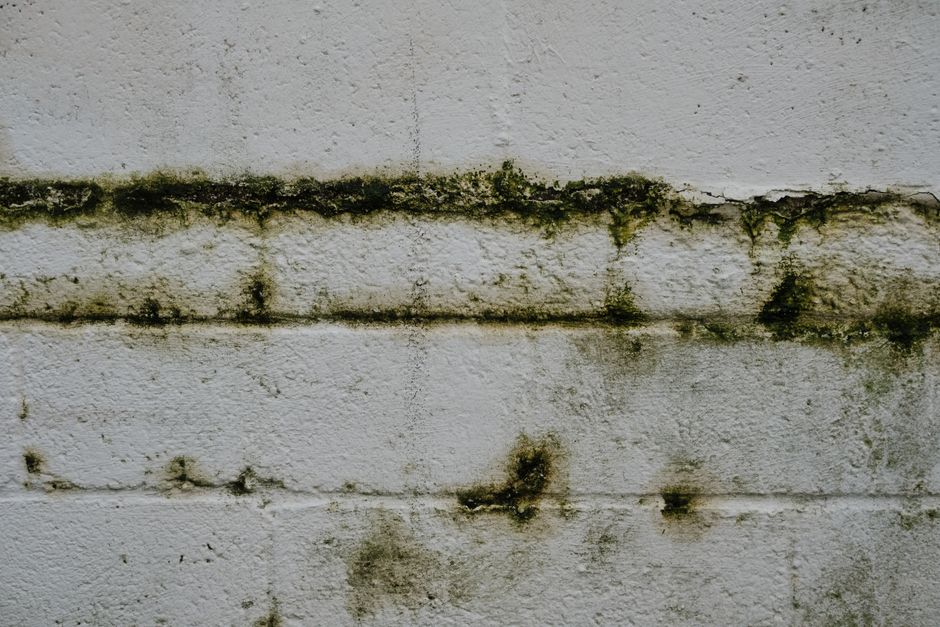
The tide mark you see is where the water finally meets the air and evaporates, leaving behind dissolved salts. Those salts are the giveaway. They are chloride and nitrate crystals carried up out of the ground, and they are why the wall feels gritty, why the paint blisters in patches that look almost geometric, why the plaster sounds hollow when you tap it.
It is not a cosmetic problem. The salts are hygroscopic — they pull moisture out of the air even on dry days — which is why the damp patch never fully disappears, even in August.
Why Limassol is particularly prone
Limassol gives rising damp a head start in ways most owners never think about.
The coastal strip is salt-laden. Air, irrigation water, and groundwater all carry chlorides that accelerate the damage and feed the cycle. Move inland to the hills above the motorway and the ground is rockier, but the slabs sit lower, foundations are often shallower than they should be, and gardens are over-irrigated against the summer.
The building stock is uneven. Older stone properties in the old town and Agios Tychonas village were built before modern damp barriers existed at all. Newer concrete-frame buildings — the towers along the seafront, the complexes in Germasogeia and Mouttagiaka — were sometimes built quickly, with the waterproofing detail at the base of the wall treated as someone else's problem. Planters built directly against the structure, podium decks with no tanking turn-up, basement car parks with hopeful drainage. We see the same omissions, repeatedly, in buildings that look immaculate from the street.
Then there is the climate rhythm. Eight dry months lull everyone into thinking the building is fine. The first serious November rain arrives in a single night, the water table rises, the ground around the foundations saturates, and the wall that looked perfect in September is showing a tide mark by Christmas. Limassol owners learn this once, usually expensively. For more on the broader pattern, see Damp and Leaks in Cyprus Villas: What's Really Going On.
What it costs you to leave it
Rising damp is patient. It does not flood a room. It does not drip from the ceiling. It works at the speed of capillary action, which is why owners convince themselves there is time.
There is not.
The plaster goes first — blown, hollow, crumbling at the skirting line. Then the skirtings themselves, then any timber in contact with the wall: door frames, built-in wardrobes, kitchen carcasses. Electrical sockets at low level corrode quietly inside the back box; you find out when something trips. Marble and stone floors lift at the perimeter as the bedding mortar saturates. In wet rooms and around pools, the damage compounds because the wall is being attacked from both sides.
The serious consequence is invisible. Chloride-laden moisture sitting against reinforced concrete eventually reaches the rebar. Steel corrodes, swells, and pushes the concrete off in sheets — the spalling you see on older balconies and soffits along the coast. That is no longer a damp problem. That is a structural problem, and it costs an order of magnitude more to put right.
There is also the quiet cost — air quality, the smell that never quite leaves the ground-floor flat, the conversation you have to have with a buyer's surveyor, the insurer who wants to know how long you have known.
How we resolve it
We start by ruling things out. A tide mark at the base of a wall can be rising damp, a failed tanking detail, a leaking buried pipe, a planter draining into the structure, or a slab that is wicking moisture from a podium above. The treatments for those are not interchangeable. Diagnosing the wrong one is how owners end up paying twice.
On the site visit we assess the affected walls and the areas feeding them — the slab edge, the external ground level, adjacent terraces and planters, basement and sub-structure conditions, any wet rooms or pool surrounds nearby. We use moisture readings, salt analysis where it matters, and the pattern of the damage itself, which tells an experienced eye a great deal. If you also have staining higher up the wall or at ceiling level, we trace that too — the two problems often share a cause. Ceiling Water Stains Limassol: What's Actually Failing Above covers that side of it.
From the diagnosis we write a clear specification: the area to be treated, the best-suited waterproofing approach for the situation, the sequence of works, and the defects documented in a report you can hand to your insurer, your building management or your lawyer if it comes to that. We then oversee vetted contractors on site so the specification is actually followed — which, in our experience, is where most jobs in Cyprus quietly fall apart.
Every job is backed by our 10-year workmanship guarantee. Not on the materials — that is the manufacturer's problem — but on the work itself, because that is the part we control and the part that almost always fails first elsewhere.
Warning signs, likely causes, areas we inspect
| Warning sign | Likely cause | Area we inspect |
|---|---|---|
| Tide mark on lower wall, salt crystals, blown plaster | Capillary rise through unbarrier'd masonry | Wall base, slab edge, external ground level |
| Damp patch behind a planter or raised bed | Planter draining into the wall or slab | Planter waterproofing, drainage, adjacent wall |
| Persistent damp on a ground-floor or basement wall | Failed or missing tanking at sub-structure | Basement walls, slab, perimeter detail |
| Tide mark on a wall adjacent to a bathroom or pool | Lateral migration from a wet room or pool surround | Wet-room substrate, pool tank, shared wall |
| Spalling concrete with rust staining at low level | Chloride attack on reinforcement | Concrete cover, exposed rebar, ground contact |
| Damp that worsens after irrigation, not rain | Over-watered garden saturating foundations | External ground level, irrigation layout, plinth |
Use it as a starting point. The site visit is what turns a guess into a specification.
Book the diagnosis before the next rain
If you have a tide mark, blown plaster or a wall that smells different in winter, the useful next step is a proper site visit — or get an instant estimate to see where you stand before we come out.
Who we work with in Limassol
We work on villas, mansions, apartment buildings and complexes — not single rooms in single flats. Owners, building managers, developers handing over a finished project, buyers who want a property assessed before completion. The common thread is that the asset is worth doing properly.
Limassol is our home turf, but the same team covers Paphos, Nicosia, Larnaca, Ayia Napa and Polis. The problems rhyme across the island; the details differ. If you want the wider context on water finding its way into a Limassol property, Water Leak Repair Limassol: Stop the Damage at the Source is a useful companion read, and Villa Waterproofing Cyprus: What Owners Don't See sets out how we think about premium properties end to end.
Frequently asked questions
How do I know it is rising damp and not a leak or condensation?
Rising damp shows as a horizontal tide mark on the lower part of the wall, usually up to around a metre, often with salt crystals or blown plaster at the edge. Condensation sits high on cold surfaces and around windows. A leak tends to be local and directional. A proper diagnosis confirms which one you actually have before anyone specifies a fix.
Will anti-damp paint or a dehumidifier solve it in my Limassol apartment?
No. Anti-damp paint traps the moisture inside the wall and pushes the problem higher up. A dehumidifier helps the air, not the masonry. Both buy you a few months of cleaner-looking walls while the substrate keeps deteriorating behind them.
Is rising damp a problem for newer buildings in Limassol, or only old ones?
Both. Older stone and brick properties lack a modern damp barrier. Newer concrete buildings get it through poorly detailed slab edges, missing tanking at basement and ground level, and planters or terraces draining into the structure. We see it across villas, mansions, apartment blocks and complexes.
Can you produce a report I can use with my insurer or building management?
Yes. We document the defects, the affected areas and the recommended scope in a clear, written report. Owners use it for insurance claims, for AGMs in shared buildings, and for holding previous contractors accountable.
How long does the work take and how disruptive is it?
It depends on what we find and where. Most jobs are scoped to minimise disruption to occupants and finishes, with works sequenced room by room or zone by zone. We confirm the timeline in writing after the site visit, not before.
Do you cover the rest of Limassol and beyond?
We work across Limassol — seafront, Germasogeia, Agios Tychonas, Mouttagiaka, the old town, the hills above the motorway — and island-wide in Paphos, Nicosia, Larnaca, Ayia Napa and Polis.
Settle it once
Rising damp does not stabilise. It progresses, quietly, until the bill changes shape. The owners who get out in front of it do one thing: they bring in someone who diagnoses the source, writes it down, and stands behind the work.
Book a site visit and we will tell you exactly what is happening at the base of your walls and what it will take to stop it — properly, once. Prefer to start a conversation first, send a photo of the affected wall on WhatsApp. Either way, every job we take on is backed by our 10-year workmanship guarantee, because the only fix worth doing is the one that holds.