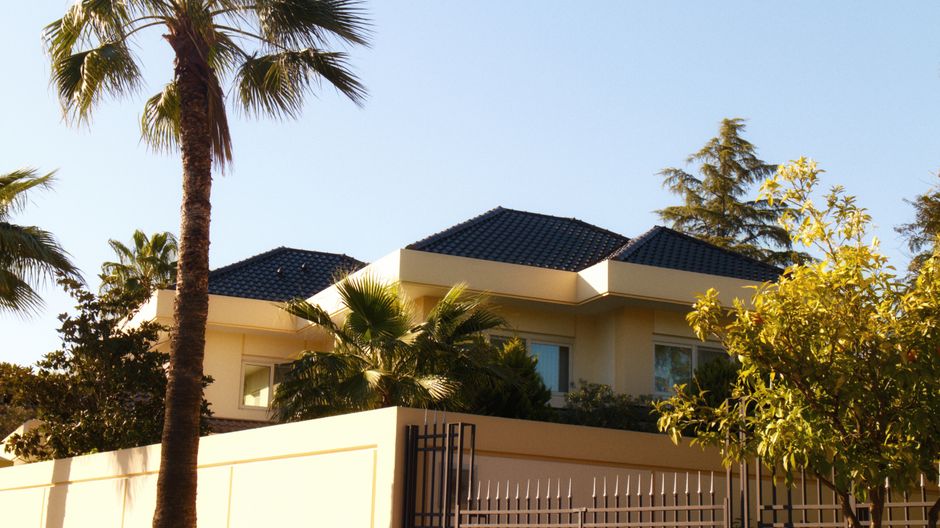
From the road, the villa looks immaculate. Pale render, clean lines, the pool catching the afternoon. Inside the parapet, a hairline crack has been drinking every winter for six years. That is villa waterproofing in Cyprus in one sentence: the failure is almost never where the owner thinks it is, and almost always older than they want to believe. We diagnose the real source, write a specification your insurer can use, oversee vetted contractors, and back the work with a 10-year guarantee.
Key takeaways
The short version, before we go deeper.
- Most Cyprus villas were never waterproofed properly at build — they were sealed, which is not the same thing.
- The first heavy November rain exposes years of quiet failure: salt-loaded air, hairline cracks, untreated parapets and tired terraces.
- Patching the stain wastes money. The fix is upstream, where the water actually enters.
- We diagnose the real source, write a defect report your insurer can use, and oversee vetted contractors to do it once.
- Every job is backed by our 10-year workmanship guarantee, across Limassol, Paphos, Nicosia, Larnaca, Ayia Napa and Polis.
What is actually happening behind a Cyprus villa's envelope
A villa is not one surface. It is a stack of details — parapet upstands, drain outlets, render terminations, pool copings, planter beds, balcony thresholds, basement tanking, terrace falls. Water finds the weakest of those details and uses it for the next twenty years. The render does not need to crack across its face. A single line two millimetres wide above a window will do.
The pattern we see, again and again, on premium properties across the island: the structure is sound, the architecture is good, the finishes are expensive — and the envelope is held together by a coat of something applied at handover and never thought about again. That worked, more or less, for the first few summers. Then the UV cooked it, the substrate moved a fraction of a millimetre with each thermal cycle, the coating lost its grip, and the building started breathing water.
Nothing dramatic happens at first. A faint shadow on a guest room ceiling. A patch of render that looks slightly darker after rain. A musty note in the basement gym that the dehumidifier almost masks. By the time anyone calls us, the timber skirting is gone, the plaster is hollow behind the paint, and the steel reinforcement somewhere in there is starting to take notice.
Why Cyprus villas fail in ways that surprise their owners
This island is unkind to lazy waterproofing in specific, predictable ways.
The rain pattern is the first one. We do not get the gentle, persistent drizzle that European detailing assumes. We get long dry months and then, in November, the sky opens for a single afternoon and delivers what should have been spread across two weeks. Every drain, every fall, every overlap is stress-tested in one go. Anything marginal fails.
The salt is the second. Coastal villas in Limassol, Paphos, Larnaca, Ayia Napa and Polis live inside an aerosol of seawater. Salt does not just corrode metal fixings. It crystallises inside porous render and concrete, pushes the matrix apart from inside, and quietly destroys the substrate the coating is meant to be bonded to. By the time you see the bloom on the wall, the layer underneath is already compromised.
The thermal range is the third. Forty in August, single digits at night in February inland. Every material on the envelope expands and contracts every day for decades. Cheap coatings do not flex with it. They craze, then crack, then lift.
And then there is the build culture. A lot of beautiful Cyprus villas were put up quickly, by good masons working to drawings that did not specify waterproofing as its own trade. The coating was whatever the site had that week. The parapet was finished by whoever was there on Friday. The pool was tiled before anyone tested the tanking. None of that is the owner's fault. All of it is now the owner's problem.
We wrote more about this pattern in Damp and Leaks in Cyprus Villas: A Tuesday Reality Check if you want the longer version.
What it quietly turns into if you leave it
The consequence ladder is steep, and almost no one climbs only one rung.
It starts cosmetic: discoloured render, paint that will not hold, a shadow under the cornice. That stage is irritating but reversible. Then it goes into the finishes — plaster blown off the wall, parquet cupping, skirtings rotting from behind, the smell of damp arriving in rooms that used to feel new. That stage costs serious money to put right, because every trade has to come back.
Then it goes into the structure. Reinforcement in concrete needs an alkaline environment to stay passive. Once chlorides and moisture reach it, it rusts; rusting steel expands; expanding steel spalls the concrete around it. On a flat roof slab or a cantilevered balcony, that is not a finish problem. That is a structural conversation, usually with an engineer, and it is the conversation no one wants to have about a villa they love.
Meanwhile, the insurance position quietly degrades. Insurers do not pay for gradual deterioration. They pay for sudden, identifiable events — and they pay them faster when the claim is supported by a proper defect report from a specialist who diagnosed the cause. Owners who waited, patched, and waited again often find themselves arguing about a number they thought was settled.
None of this is theoretical. We see it every winter.
How WATERPROOFED.cy resolves villa waterproofing, properly
Our process is deliberately unglamorous, because that is what makes it work.
We diagnose first. Before anyone proposes a scope, we walk the property and read it — roof and parapets, facades, terraces and verandas, balconies, ground-level structures and any basement, the pool surround, planters, wet rooms, exposed concrete. We are looking for the source of the water, not the symptom on the ceiling below it. Those are almost never in the same place.
We specify the right approach for the situation. Every area of a villa wants something different. A south-facing parapet that bakes all summer is not the same problem as a planter bed that stays wet for months, which is not the same problem as a pool deck that moves with the slab beneath it. We choose what suits each area, and we write that specification down. We never apply the same thing everywhere because it is convenient — that is how envelopes fail in the first place.
We document the defects in a report you can use with insurers. Photographs, locations, causes, recommended scope. That report is yours. If there is a claim to make, it is already half-prepared. If there is no claim, you still have a baseline document for the property, which matters at resale.
We oversee vetted contractors on site. This is the part most owners did not get the first time around. The trades we use are people we have worked with for years, and they work to our specification under our supervision — not to their habits under no one's. We are on site at the stages that matter, and we sign off only what was actually done.
We stand behind it for ten years. Every job is backed by our 10-year workmanship guarantee. We can offer that because the diagnosis was ours, the specification was ours, and the supervision was ours. If you would like the longer view of how a specialist firm should operate on premium properties, Waterproofing Specialist Cyprus: What Owners Actually Need covers it.
Reading the warning signs before they become finishes work
A quick reference for what you might be seeing. None of these are conclusive on their own. All of them are worth a phone call.
| Warning sign | Likely cause | Area we inspect |
|---|---|---|
| Shadow or stain on a top-floor ceiling | Failed roof membrane or parapet upstand | Flat roof, parapets, drain outlets |
| Salt bloom or flaking paint on a sea-facing wall | Salt-driven render breakdown, hairline cracking | Facade, render terminations, window heads |
| Soft or hollow plaster behind a skirting | Water tracking down inside the wall from above | Balcony threshold, terrace fall, window sills |
| Musty smell in a basement or lower ground room | Rising damp or lateral ingress through retaining walls | Sub-structure, tanking, ground-level junctions |
| Tiles lifting or grout discolouring around a pool | Failed tanking behind the tiles, movement at coping | Pool shell, coping, surrounding deck |
| Damp patch under a planter or raised bed | No waterproof layer between soil and structure | Planter linings, drainage, slab below |
| Rust streaks on exposed concrete soffits | Carbonation and chloride attack reaching reinforcement | Exposed concrete, balcony soffits, cantilevers |
Book the diagnosis before the next rain does it for you
If any of the table above looks familiar, the cheap version of this conversation is the one we have now, in dry weather, with time to plan. You can get an instant estimate on the homepage, or book a site visit and we will come and read the property properly.
Frequently asked questions
Does my villa actually need waterproofing if there are no visible leaks?
Almost certainly, yes. Visible leaks are the late stage. By the time a stain appears on a ceiling or a salt bloom shows on a wall, water has been moving through the structure for months or years. A proper inspection finds the entry points before they become interior damage, which is the cheaper conversation by a wide margin.
When is the best time of year to waterproof a villa in Cyprus?
Late spring through early autumn, while substrates are dry and stable. Work carried out in summer cures properly and is tested by the first real rains of November. Leaving it until the rains have started usually means emergency patching now and proper remediation later — twice the disruption, none of the guarantee.
We already had the roof sealed when the villa was built. Isn't that enough?
Rarely. Most Cyprus villas were sealed, not waterproofed — a thin coating applied quickly, often without proper detailing at parapets, drains, upstands and penetrations. Ten or fifteen Cyprus summers later, that coating is exhausted. The structure underneath is sound; the envelope around it needs to be specified and rebuilt properly.
How long does a full villa waterproofing project take?
It depends on the areas involved and what the diagnosis reveals, but most villa scopes are measured in days to a few weeks, not months. We programme the work to minimise disruption to occupied homes and document each stage. You receive a clear specification before anyone lifts a tool.
Do you work on the whole envelope, or just one problem area?
Both. Some clients call us about a single terrace or a basement; others want the entire envelope assessed — roofs, facades, balconies, pools, planters and ground-level structures. We are comfortable at either scale, and we tell you honestly when a small scope is enough or when it is not.
What does the 10-year guarantee actually cover?
Our workmanship across every scope we specify and supervise. If something we have signed off fails within ten years, we return and resolve it. That is only possible because we diagnose properly upfront, write the specification ourselves, and oversee vetted contractors on site — we are not guaranteeing someone else's guess.
Talk to us before the season turns
A villa is a long investment. The envelope that protects it should be treated like one. If you would like a specialist to walk the property, diagnose what is actually happening, and put a clear specification on paper — backed by our 10-year workmanship guarantee — book a site visit, or message us on WhatsApp. We work across Limassol, Paphos, Nicosia, Larnaca, Ayia Napa and Polis, and we would rather meet you in August than in November.