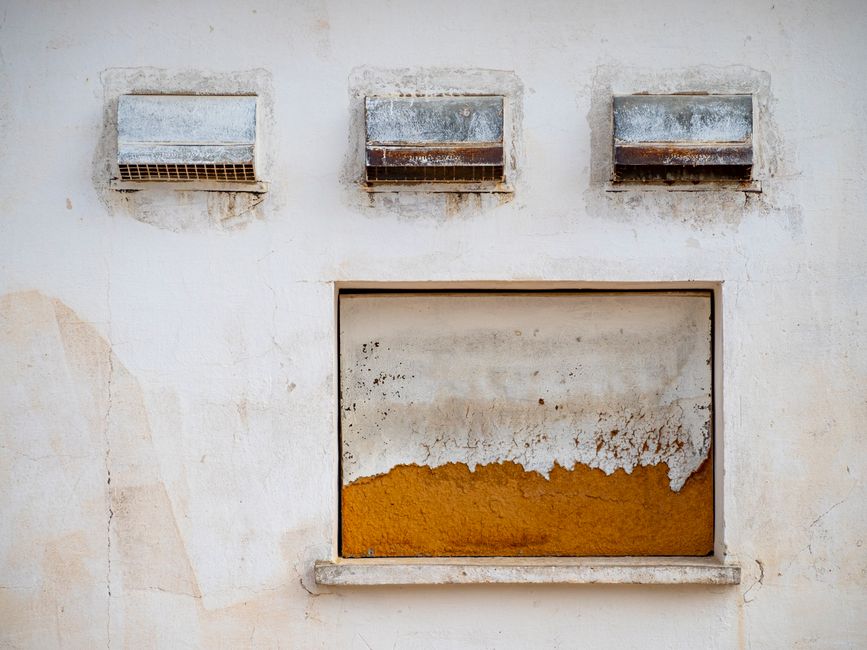
Rust bleeding through render on a Polis balcony is not a stain. It is the structure telling you water has reached the steel — and steel, once it starts to rust, does not stop politely. Rebar corrosion and concrete cancer in Polis is almost always a waterproofing failure that has been ignored for a season or three. Catch it early and the repair is contained. Leave it, and you are eventually rebuilding sections of slab, beam or column.
That is the short answer. The longer one — why it happens here, what it costs to look away, and how we resolve it once — is below.
Key takeaways
The whole page in five lines:
- Rebar corrosion and concrete cancer in Polis almost always begin with unmanaged water — coastal air, first-rain flooding, and untreated concrete surfaces.
- Rust stains, hairline cracks along a beam line, and small blown patches are early warnings, not cosmetic issues.
- Left alone, the steel expands and pushes the concrete off in sheets, eventually reducing the section's load capacity.
- The fix is diagnostic-led: find the water path, specify the right repair for the area, oversee vetted contractors, and document the defect for insurers.
- Every job we oversee is backed by our 10-year workmanship guarantee, across Polis and the wider Akamas.
What is actually happening inside the concrete
Reinforced concrete is a partnership. The concrete handles compression, the steel bars inside handle tension, and a thin alkaline layer around each bar keeps the steel passive — essentially rust-proof — for as long as that layer stays intact.
Two things break that partnership. Water gets in through a crack, a porous surface or a badly detailed edge and slowly carries carbon dioxide down to the bar, neutralising the alkalinity. Or chloride from coastal air and salt spray reaches the bar and attacks it directly. Either way, the steel starts to rust.
Here is the cruel bit of physics. Rust occupies several times the volume of the original steel. As the bar corrodes it swells, pressing outward against the concrete cover from the inside. First you get a rust-coloured tear-line on the surface. Then a hairline crack tracking the bar. Then a hollow patch that sounds dead when you tap it. Then, one morning, a plate of concrete on the floor and the reinforcement exposed to the weather. That process is what people around Cyprus call concrete cancer, and the name earns itself — it spreads along the bar, jumps to neighbouring bars, and quietly eats structural section.
Why Polis properties are especially exposed
Polis and the Akamas coast are not kind to reinforced concrete, and pretending otherwise helps nobody.
The air off Chrysochous Bay carries chloride further inland than owners expect. Villas set back in Prodromi or Neo Chorio still see salt-laden wind against the seaward facades, and pool decks catch a double dose from chlorinated water and coastal spray. Add the local rain pattern — long dry months, then the first November downpour arriving all at once — and every unsealed roof edge, untreated parapet and open planter suddenly becomes a funnel.
Then there is the way many properties around Polis were built. Fast, at scale, during a busy decade. Slabs poured with thin cover to the steel. Verandas cast without a proper falls detail. Bare concrete parapets that were meant to be waterproofed "later" and never were. Balcony drips that discharge straight onto the beam below. Individually, none of these is dramatic. Together, they are exactly the conditions rebar corrosion needs.
The cultural piece matters too. There is a habit here of noticing the stain in autumn, promising to deal with it in spring, and forgetting by summer. If you have been telling yourself the same thing for two winters, this is your reminder. Related reading on the same theme: what's really going on with damp and leaks in Cyprus villas, and the local pattern behind water leak repair around the Akamas coast.
The early warning signs owners keep dismissing
Concrete cancer rarely announces itself. It hints, for a long time, before it shouts.
Rust-coloured weep marks running down a soffit or a column face. A crack that follows a suspiciously straight line — because it is tracking the bar underneath. A patch of render that sounds hollow under a knuckle. Small pop-outs on a balcony edge. A ceiling stain that keeps returning to the same spot no matter how often it is repainted. Efflorescence blooming near a beam. If any of that is familiar, the ceiling stain diagnostic is worth a read.
None of these signs is the actual problem. They are the receipts for a water path that has been open for a while.
Warning signs, likely causes, and where we look
| Warning sign on the property | Likely underlying cause | Area we inspect first |
|---|---|---|
| Rust weep on balcony soffit or column | Water tracking to reinforcement through cover concrete | Balcony/veranda slab, drip detail, parapet |
| Straight-line crack along a beam or slab edge | Corroding bar expanding beneath the surface | Beam soffit, slab underside, cover depth |
| Hollow-sounding patch, small blown fragments | Advanced corrosion — cover already lifting | Local slab or column, adjacent reinforcement |
| Repeating stain on the same ceiling spot | Failed roof, terrace or bathroom waterproofing above | Roof, flat roof, wet room, terrace above |
| Rust bleed near a pool coping or planter | Chloride and standing water reaching embedded steel | Pool surround, planter tanking, drainage |
| Salt-white bloom near a corroding bar | Moisture movement carrying salts through concrete | Wall, facade, ground-level substructure |
What it costs to look away
No prices here — the real cost of ignoring rebar corrosion is not measured in euros, and pretending otherwise misses the point.
A small blown patch on a balcony edge, caught early, is a contained repair. The same defect left for three winters becomes structural. Load paths change. A beam that has lost a third of its effective steel section is a very different animal from the one the engineer designed. On apartment buildings and complexes, that turns into a common-parts problem, a management-committee problem, and eventually an insurance problem — usually at the worst possible moment, with a buyer's surveyor standing on the terrace.
The softer costs stack up too. Ruined interior finishes below the leak. Repainting the same ceiling every spring. Tenants asking questions. Rentals off the market during peak weeks because a soffit chose July to give up. And the quiet one: a property that photographs beautifully but does not survive a serious pre-purchase inspection.
The habit of "we'll deal with it next year" is the single most expensive line in Cypriot property ownership. We would rather you never say it.
If you have seen rust bleed on the same ceiling twice, you do not have a paint problem. You have a structural conversation waiting to happen — and it is cheaper to have it now.
Ready when you are
If something on your Polis property matches what you have just read, the sensible next move is a site visit. You can also get an instant estimate in a couple of minutes to frame the scale of the work.
How WATERPROOFED.cy resolves rebar corrosion, properly and once
We work the problem in a specific order, because the order is what makes the repair hold.
Diagnose the real source. Before anyone touches the concrete, we work out where the water is entering and how it is reaching the steel. That might be a failed roof detail, a parapet that was never sealed, a planter draining into a wall, a pool surround leaking into the deck, or a shower tray on the floor above. Half the reason cosmetic patches fail is that nobody asked this question. We do — and we start where the water starts, whether that means the roof, a terrace, a facade, a basement, a pool surround or a wet room.
Select the best-suited approach for the area. Every zone of a building behaves differently. A flat roof, a coastal facade, a pool coping, a below-grade basement wall and a balcony soffit each need a specification tailored to what they actually do — the exposure, the movement, the substrate. We do not turn up with one favourite product looking for problems to solve. We match the approach to the situation. If the spalling and concrete-cancer repair sequence sounds relevant to your property, that piece explains the same logic from the concrete side.
Document the defect for insurers and committees. Every diagnosis is written up. Photographs, locations, cause, recommended scope. It is the document you want in a claim, a service-charge discussion, a sale, or a future dispute with a builder. Owners of apartment buildings and complexes tell us this is often the part they value most, because it turns a vague problem into a defensible file.
Oversee vetted contractors on site. The trades we work with have been chosen over years, not weeks. We specify the works, we supervise the execution, and we sign off only when it matches the specification. You are not being handed a phone number and left to negotiate.
Back it with a 10-year workmanship guarantee. Every project we oversee carries our 10-year workmanship guarantee. That is the honest expression of how confident we are that the diagnosis was right and the work was done properly. Guarantees are easy to write and harder to mean. We mean this one.
Why owners choose us for this specific problem
Plenty of trades in Cyprus will repair a blown patch. Very few will find out why it blew.
We work on villas, mansions, apartment buildings and complexes across Polis, Paphos, Limassol, Nicosia, Larnaca and Ayia Napa. We are specialists, not generalists — waterproofing and the structural consequences of water is what we do, every day, on serious properties. The clients we work best with are the ones who would rather spend one considered season fixing the cause than five casual seasons chasing the symptom.
If that is you, we are the right call.
Frequently asked questions
Is a rust stain on my Polis balcony ceiling actually serious?
Yes — treat it as a warning, not a mark. A rust stain means moisture has already reached the reinforcement inside the slab. The steel is corroding and expanding, and the concrete cover will eventually crack and fall. The earlier we diagnose the water path, the less structural repair you need.
Why does concrete cancer show up so often on Polis and Latchi properties?
Two reasons. Coastal air carries chloride that accelerates steel corrosion once moisture gets in, and many buildings around Polis were finished at speed with thin concrete cover and no proper waterproofing to the roofs, verandas or planters. The first heavy autumn rain finds every unsealed edge.
Can you just patch the blown area and repaint it?
You can, and it will return — usually within a season or two, often worse. A cosmetic patch traps moisture behind fresh mortar and hides the real water path. We diagnose where the water is entering, resolve that first, then carry out the structural repair so the fix holds.
Do you produce a report we can use with our insurer or building committee?
Yes. Every diagnosis is documented — photos, locations, cause, recommended works and scope. It is written so an insurer, a management committee or a future buyer can follow exactly what was found and what was done. That paperwork often matters as much as the repair itself.
How far around Polis do you work?
Polis, Latchi, Neo Chorio, Prodromi, Argaka and the villages up toward the Akamas. We cover villas, apartment buildings, complexes and commercial premises island-wide, so if your property sits between Polis and Paphos we can look at both in the same visit.
What does the 10-year workmanship guarantee actually cover?
It covers the waterproofing and repair works we specify and oversee on your property for ten years. If the work we signed off fails within that period, we return and put it right. It is a guarantee on our diagnosis and supervision, not a disclaimer buried in fine print.
Book the visit before the next rain
The first serious rain of the season decides how bad the next twelve months will be. If your Polis property has rust weep, hollow patches, straight-line cracks or a ceiling stain that keeps coming back, that is the conversation to have now — not in February.
Book a site visit with WATERPROOFED.cy and we will diagnose the real source, specify the right repair for the affected area, document the defect for your records, and oversee the works through to a signed-off finish. Every project is backed by our 10-year workmanship guarantee. If it is easier, message us on WhatsApp with a photo or two and we will tell you honestly whether it warrants a visit. Or get an instant estimate in a couple of minutes and go from there.
Once, properly, on the record. That is the standard.