Most owners in Larnaca meet penetrating damp the same way: a stain appears after the first heavy rain, somebody brushes on waterproof masonry paint or a tube of sealant, and for a few weeks it looks handled. Then November arrives all at once and the patch returns, larger, with company. Penetrating damp is water crossing the wall horizontally through a real defect — a cracked render, a failed joint, a tired parapet, a window detail that gave up two summers ago. Paint cannot close a defect it is sitting on top of. You have to find the entry point and treat the wall properly, or you are just decorating a leak.
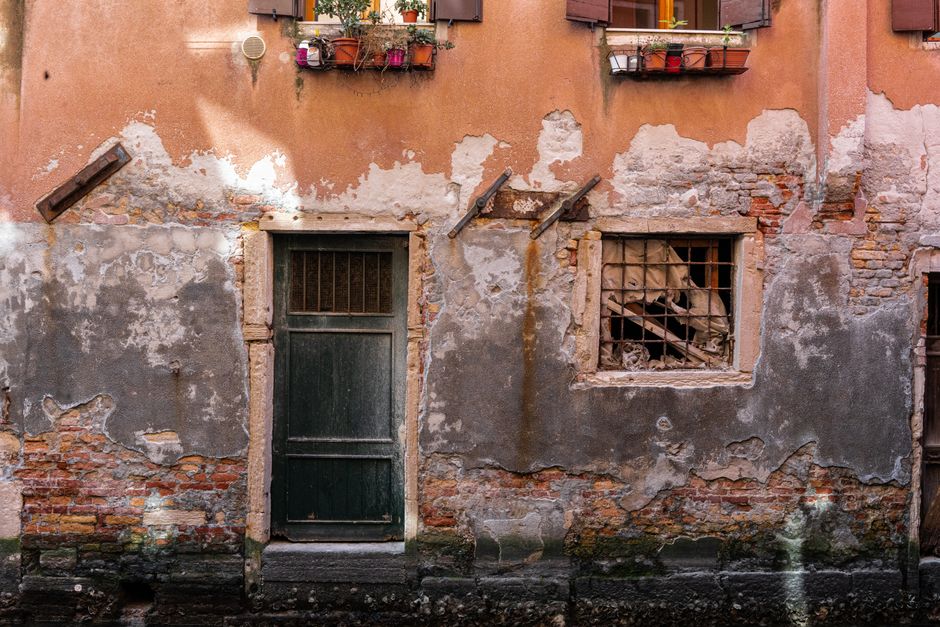
Key takeaways
The short version, before we get into the detail:
- Penetrating damp moves sideways through the wall, not up from the ground.
- In Larnaca, salt air, wind-driven rain and exposed concrete make facades fail earlier than owners expect.
- Surface fixes — masonry paint, mastic, a quick render patch — almost never hold past one wet season.
- A proper repair starts with diagnosis: locating the real entry point and the area behind it.
- Our work is overseen on site and backed by a 10-year workmanship guarantee.
Why the quick-fix patch never holds
When a damp patch shows up on an internal wall, the instinct is reasonable enough: cover it, seal it, paint over it, move on. The problem is that penetrating damp is a wall failure, not a finish failure. The water is already inside the masonry by the time you see it indoors. Anything you apply to the inside face is downstream of the actual problem.
The three most common quick fixes we are called to undo are nearly identical every time. Waterproof masonry paint brushed onto a damp external wall — it blisters and peels because the substrate was never dry. A bead of polyurethane sealant around a window or balcony junction — it bridges the visible gap but ignores the cracked render two courses above, where the water is actually getting in. A thin skim of cementitious render over a tired facade — it cracks along the same lines as the original within a season because the movement behind it has not been addressed.
None of these are bad materials. They are simply being asked to do work they were not designed for, on a surface that was never prepared, sealing a defect nobody bothered to find. The result is predictable. The owner spends twice — first on the patch, then on the proper repair — and lives with the damage in between.
What penetrating damp actually is
Penetrating damp is the lateral movement of water through a wall, from outside to inside, via a defect in the external envelope. That defect can be obvious or invisible. It might be a hairline crack in render, a failed mortar joint, a delaminated coating on exposed concrete, a parapet cap with an open seam, a window reveal where the seal has dried out, or a downpipe leaking onto a wall for years without anyone noticing.
Water does not need much. A crack you can barely fit a fingernail into is enough, particularly when wind pushes the rain horizontally rather than letting it fall. Once inside the masonry, the moisture migrates until it finds a way out — usually onto an internal finish, where you finally see it as a patch, a halo, a bubble in the plaster, or the slow grey bloom of mould in a corner.
This is why penetrating damp can appear nowhere near the actual defect. A wet patch on a bedroom wall might trace back to a parapet two metres above, on the other side of the house. Following the water back to its source is the whole job.
Why Larnaca walls fail the way they do
Larnaca's climate is gentle on people and brutal on facades. The coastal air carries salt that works its way into mortar joints and concrete pores, slowly weakening them. Long dry summers bake hairline cracks open. Then the rain arrives — often not gradually, but in a single heavy week — and finds every weakness at once. South and east-facing walls take the worst of the wind-driven rain off the bay.
Layered on top of that, the local building stock has its own quirks. A lot of Larnaca property — from villas in Pyla and Oroklini to apartment blocks behind the seafront — was built quickly, with exposed concrete elements that were never properly coated against the marine environment. Balcony slabs, parapet walls, planters, sunshades and decorative bands are the usual suspects. Each one is a potential entry point.
For a wider view of how damp behaves across the island's building stock, our piece on damp and leaks in Cyprus villas covers the broader pattern. For the cousin problem of moisture coming up rather than across, see rising damp in Larnaca — the diagnosis is different, and confusing the two wastes everyone's time.
What it costs to leave alone
The stain is the cheapest thing penetrating damp will ever cost you. Left running for a season or two, the consequences compound quietly:
Plaster debonds from the wall behind it and has to be hacked off and re-skimmed. Skirting boards, joinery and built-in cabinetry warp, swell and stain. Mould establishes in the corners and behind furniture, with the health and air-quality consequences that follow. Reinforcing steel inside concrete elements — balconies, sunshades, parapets — begins to rust, expand, and crack the concrete from the inside out. That last one is the serious one, because by the time you can see it, you are no longer talking about a damp repair. You are talking about structural work.
There is also the insurance angle. Damage from a sudden event is one thing; damage from a defect you knew about and did not address is another. Insurers respond very differently to a documented report from a specialist than they do to a homeowner's description of "some damp". If you are seeing patterns related to leaks rather than damp specifically, our notes on water leak repair in Larnaca and ceiling water stains in Larnaca are worth a read alongside this one.
How we actually resolve it
Our work begins with diagnosis, not a quote for a coating. We come to the property, we look at the affected internal areas, and then we go outside and find the defect. That means inspecting the wall, the openings, the parapet, the adjacent roof edges, the rainwater goods, the exposed concrete elements — everything that could be the actual source. We do not assume; we trace.
Once we know what is failing and where, we write a clear specification of the work, area by area. We document every defect in a report you can hand to your insurer or your management company without translation. Then we oversee the work on site, using contractors we have vetted and worked with before. We do not subcontract the responsibility — we stay on the job until it is right.
The approach we apply is chosen for the situation. A wind-driven failure on a rendered facade is not the same problem as a parapet that has been wicking water for a decade, and neither is the same as a balcony slab leaking onto the wall below. We select the best-suited approach for the area in question — that is the work, and it is why we do not sell a single product or system. The wall tells us what it needs.
Every job we complete is backed by our 10-year workmanship guarantee. Not because guarantees sell — because if we have done it properly, we should be willing to stand behind it for a decade. If we are not, we should not be doing the job.
Warning signs, likely causes, and where we look
A quick reference for what you are probably seeing and what it usually means in a Larnaca property:
| Warning sign | Likely cause | Area we inspect |
|---|---|---|
| Damp patch mid-wall, returns after rain | Cracked render or failed mortar joint on the external face | Facade, window reveals, expansion joints |
| Stain along the top of an internal wall | Parapet or roof-edge detail letting water down the cavity | Parapet caps, roof-to-wall junction, flashings |
| Bubbling paint near a window or door | Failed seal at the opening or cracked reveal | Frames, reveals, lintels, sill detail |
| Damp corner under a balcony above | Balcony slab edge or underside leaking onto the wall | Slab edge, drip detail, balcony waterproofing |
| Patches on a wall behind a downpipe | Leaking or detached rainwater goods soaking the wall | Gutters, downpipes, fixings, splashback area |
| Persistent mould in a single internal corner | Cold bridge combined with a small ongoing water ingress | External corner detail, insulation continuity, render condition |
If two or three of these are familiar, the property is already telling you what it needs.
Book the diagnosis, not the patch
If you can see the signs above on a Larnaca property, the next step is a proper site visit — not another tube of sealant. You can get an instant estimate on the homepage to see roughly where you stand, then book a visit so we can look at the actual wall.
Why owners choose us over a general contractor
Most contractors in Cyprus are perfectly capable of applying a coating. Far fewer are set up to diagnose why a wall is failing, document it for an insurer, specify the correct work, and stand behind it for ten years. That gap is the reason we exist.
We work on villas, mansions, apartment buildings and complexes across Larnaca, Limassol, Paphos, Nicosia, Ayia Napa and Polis. The properties differ; the discipline does not. Diagnose the real source. Specify the right work for that area. Oversee vetted contractors on site. Document everything. Guarantee the workmanship for a decade. That sequence is the whole product.
If your property has reached the point where the salt air is the louder problem, our note on roof leak repair in Larnaca is a useful companion read — penetrating damp on upper walls and roof failures often arrive together along the coast.
Frequently asked questions
How do I tell the difference between penetrating damp and rising damp?
Rising damp climbs from the floor and stops at a tide line, usually around a metre up. Penetrating damp appears wherever the water gets in — mid-wall, around a window, behind a downpipe, on the inside of an external corner. If the patch is high, isolated, or follows the weather, it is almost certainly penetrating.
Why does penetrating damp seem worse in Larnaca than inland?
Coastal air carries salt that erodes mortar joints and degrades old coatings faster than dry inland conditions. Add wind-driven rain off the bay and any hairline crack on a south or east-facing wall becomes a funnel. The wall does not need to be in bad shape to leak — it just needs one weak point.
Can I just repaint the wall with waterproof masonry paint?
Not reliably. Coatings applied over a wet or contaminated substrate trap moisture and lift within months. Worse, they hide the source while the wall behind continues to deteriorate. The paint is the last step of a proper repair, never the repair itself.
Does my insurer need a damp report?
If you intend to claim for damaged finishes, ruined contents or consequential repairs, yes. A documented report establishing cause, location and extent makes the difference between a paid claim and a polite refusal. We produce reports written for that purpose.
How long does the work take on a typical Larnaca villa or building?
It depends entirely on what we find — a single facade panel is days, a whole elevation with parapets and openings is longer. We give you a clear scope and timeline after the site visit, not before. Honest answers beat optimistic ones.
Do you only work on villas?
No. We work on villas, mansions, apartment buildings, complexes and premium properties across Larnaca and the rest of Cyprus. The principle is the same at every scale: diagnose properly, document, oversee the work, guarantee it.
Talk to us before the next wet week
Penetrating damp does not improve with time, and Larnaca's rainy weeks have a habit of arriving without much warning. The best moment to address it is now, while the wall is still telling you something quietly. Book a site visit and we will come and look at the property properly — or message us on WhatsApp if that is easier. Either way, you get a real diagnosis, a clear scope, a report you can use, and work that is backed for ten years. That is the only kind of repair worth paying for.