Walls don't sweat by accident. In Larnaca, condensation is what the building is telling you about its envelope — the warm, humid coastal air meeting surfaces that are too cold, too thin, or too poorly detailed to handle it. Treat it as a cleaning problem and you'll be repainting the same corner every spring. Treat it as a building problem and you fix it once.
This page is for owners and managers of properties in Larnaca who are tired of the black spotting behind the wardrobe, the musty smell after a still November night, and the slow blistering around the window reveal. We'll explain what's actually happening, why Larnaca in particular punishes lazy detailing, what it quietly turns into if left, and exactly how we resolve it.
Key takeaways
The short version, before the detail:
- Condensation problems in Larnaca are a building-physics issue — warm humid air meeting cold surfaces — not a housekeeping failure.
- The early signs are black spotting in corners, around windows and behind furniture, with a musty smell after still humid nights.
- Ignored, it degrades paint and plaster, fuels mould, lifts skirting, and ultimately reaches the reinforcement inside the concrete.
- Ventilation alone rarely solves it on the coast; the cold surfaces and thermal bridges have to be addressed.
- We diagnose the real source, write an insurer-ready report, oversee vetted contractors, and back every job with a 10-year workmanship guarantee.
What's actually happening on your walls
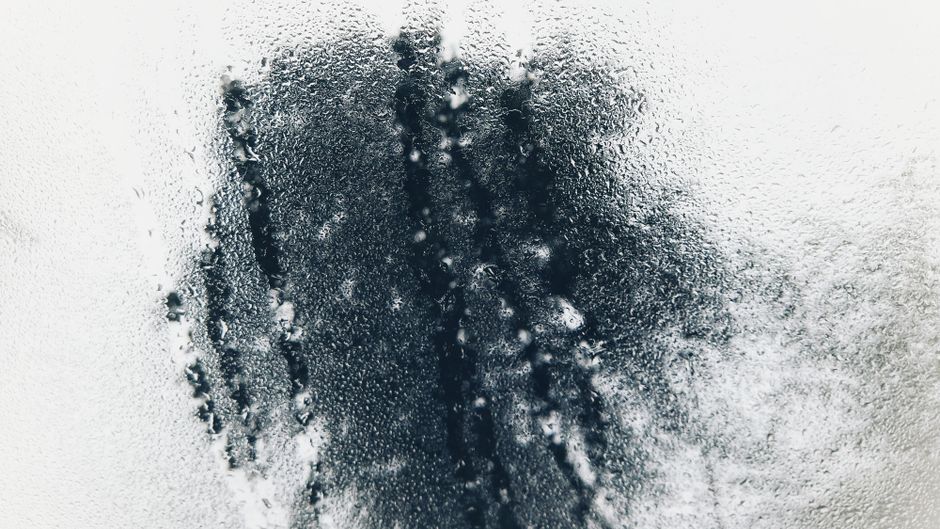
Air holds water. Warm air holds a lot of it. When that warm, moist air touches a surface that is colder than its dew point, the water has to go somewhere — and it goes onto the wall, the ceiling corner, the inside of the window reveal, the back of the wardrobe pushed against the north elevation. That's condensation. Not mysterious. Not your fault for cooking pasta.
In a well-built, properly insulated building, the inside surfaces stay warm enough that this rarely happens. In most of what's been built in Cyprus over the last forty years — bare concrete frame, thin block infill, minimal or non-existent thermal break, single-glazed aluminium reveals — the inside face of an external wall in February is genuinely cold. Cold enough that a quiet, humid night does the rest.
The mould that follows isn't a separate problem. It's the visible bit. Mould needs moisture and a surface; condensation provides both, reliably, in the same spots, every winter.
Why Larnaca specifically punishes this
Larnaca sits on the sea, with the salt lake on one side and the bay on the other. Ambient humidity stays high for most of the year, and it spikes in the shoulder seasons when the building is neither heating nor cooling. The first proper rain in November tends to arrive all at once, dropping temperatures sharply while the air is still saturated. That is the perfect condensation event.
Then there's the building stock. Coastal Larnaca — Mackenzie, the marina strip, Pyla, Oroklini, Livadia — is full of properties built fast, in bare concrete, with thermal bridges at every slab edge, balcony, lintel and column. Those bridges are colder than the surrounding wall. Condensation finds them first. Walk into almost any apartment built before 2010 in February and you can map the structural frame from the mould pattern alone.
Salt air makes it worse in a way that is easy to underestimate. Once moisture is sitting in the wall build-up, the chlorides accelerate corrosion of the reinforcement inside the concrete. That's how a cosmetic stain becomes a structural conversation. For more on how coastal air drives broader failures here, our note on roof leak repair in Larnaca is worth reading alongside this one.
And then there is the cultural piece — the very Cypriot habit of "we'll deal with it next year." Next year the paint is worse, the plaster is softer, and the steel has had another twelve months of damp company.
The cost of leaving it
Condensation is the slow kind of damage. It rarely arrives as a crisis. It just keeps going.
First the paint goes — bubbling at the top of the wall, flaking around the window reveal. Then the plaster behind it softens and loses its key. Skirting boards swell and lift. Wardrobes pressed against the cold wall develop a black bloom on the back that you only see when you move out. Soft furnishings start to smell, and the smell doesn't leave with an open window because the source is in the wall.
Then the health piece, which we'll mention once and move on: persistent indoor mould is not something you want children, asthmatics or elderly residents living with. It's a real reason tenants leave and buyers walk away from otherwise excellent apartments.
Further in, the concrete itself starts to suffer. Moisture-laden, salty air reaches the reinforcement; the steel rusts; the rust expands; the concrete spalls. At that point you're no longer talking about a damp patch. You're talking about structural repair. Our broader piece on damp and leaks in Cyprus villas walks through how these failures compound when nobody is reading the building properly.
A dehumidifier will not save you from any of this. It will run, and the meter will run with it, and the wall will still be cold.
Reading the signs
Most owners we visit already know something is wrong — they just can't tell whether they're looking at condensation, a leak, or rising damp. The pattern matters, because the fix is completely different.
| Warning sign | Likely cause | Where we inspect |
|---|---|---|
| Black spotting in top corners and around window reveals | Surface condensation on cold spots and thermal bridges | External wall build-up, reveals, slab edges |
| Musty smell after still, humid nights; worse in winter | Interstitial or surface condensation in the envelope | Wall and ceiling build-ups, ventilation paths |
| Mould on the back of furniture against an external wall | Cold internal surface, restricted air movement | External wall thermal performance, layout |
| Damp patch that appears after rain, then dries | Penetrating leak, not condensation | Roof, parapet, facade, joints — see our water leak repair Larnaca notes |
| Tidemark up to about a metre on lower walls | Rising damp, not condensation | Ground-level and sub-structure detailing — see our rising damp Larnaca piece |
| Brown staining on the ceiling | Water from above, not condensation | Roof, terrace, plumbing — see ceiling water stains Larnaca |
If two or three of these apply at once, you very likely have more than one problem. That's normal. It's also exactly why a proper diagnosis matters before anybody opens a tin of anything.
Book the diagnosis, not the guess
If the pattern above sounds like your property, the next move is a site visit — or get an instant estimate for the scope you're already sure about. We'd rather you book the diagnosis than buy another dehumidifier.
How WATERPROOFED.cy resolves condensation problems in Larnaca
We approach condensation the way a good doctor approaches a recurring symptom — by finding the cause, not numbing the patient. The work breaks down into four stages, and we do all of them.
Diagnosis on site. We come to the property. We read the building. We look at where the cold surfaces are, where the moisture is being generated, how the air actually moves through the space, and where the thermal bridges sit. We check the roof, the facade, the reveals, the ground-level detailing and — where relevant — the basements, sub-structures, terraces and balconies. Condensation is rarely just one thing. Often it's hiding alongside a small penetrating leak or a tired roof detail that's been adding moisture to the equation for years.
Specification. We write a clear, defect-by-defect specification of what needs to happen and in what order. No vague "apply a coating." A real document, with photographs, that an owner, a manager, an insurer or a buyer can read and act on.
The right approach for the area. Condensation work touches different parts of the envelope depending on what we find — the roof, the facade, the reveals, the wet rooms, sometimes exposed concrete that's been left to weather. We select the best-suited waterproofing and envelope approach for each affected area. We will not name a product on a webpage and pretend it's the answer to every building. That's not how this works.
Oversight on site. We oversee vetted contractors through the work. Same people, same standards, job after job. This is the bit that quietly separates a fix that lasts from a fix that looks great for one summer.
And the whole thing carries our 10-year workmanship guarantee. Not a leaflet promise — the reason we're so careful at the diagnosis stage in the first place.
Why owners and managers choose us
A short, honest list. We diagnose the real source instead of patching the symptom. We write a specification you can hand to an insurer or a board without translation. We oversee the people doing the work so the spec is what actually gets built. We work on villas, mansions, apartment buildings and complexes across Larnaca, Limassol, Paphos, Nicosia, Ayia Napa and Polis. And every job is backed by the 10-year guarantee.
Most Cyprus buildings and villas are not properly waterproofed. The ones we leave behind us are. That's the entire business.
Frequently asked questions
Is condensation in my Larnaca apartment my fault for not opening windows?
Almost never. In a coastal climate like Larnaca's, the outside air is often more humid than the inside, so "just ventilate more" can make things worse. The real driver is cold surfaces — uninsulated walls, thermal bridges, single-glazed reveals — where humid indoor air condenses. That's a building issue, not a habit issue.
How do I tell condensation apart from a leak or rising damp?
Condensation tends to appear on cold surfaces, in corners, behind furniture and around window frames, and it's worst in winter and on still humid nights. Leaks are localised and often follow rain. Rising damp shows as a tidemark on lower walls. We diagnose all three on a site visit so you stop guessing.
Won't a dehumidifier or extractor fan solve it?
Sometimes it helps. Often it just masks the underlying issue while mould keeps growing behind wardrobes and inside wall build-ups. If the surfaces are cold enough, water will keep condensing no matter how hard the machine runs. The fix is to address the cold surfaces and the moisture sources together.
We're right by the sea in Larnaca — does that make condensation worse?
Yes. Coastal Larnaca runs high ambient humidity year-round, and salt-laden air accelerates corrosion once moisture gets into concrete and reaches the steel inside. Properties in Mackenzie, the marina, Pyla and Oroklini tend to show it earlier and more aggressively than inland builds.
Can the report you produce be used with our insurer or building management?
That's exactly what it's designed for. We document every defect, photograph it, and write a clear specification of the work required. Insurers, management companies and resale buyers all take a properly written specialist report seriously.
Do you only work on villas, or also on apartment buildings and complexes?
Both. We work on villas, mansions, apartment buildings and complexes across Larnaca and the rest of Cyprus. Shared structures often need the diagnosis even more, because condensation in one apartment is frequently a thermal-bridge or envelope issue affecting several.
Settle it before the next humid night
If you've read this far, the wall has probably been telling you the same story for a while. The right answer is not another coat of paint and a hopeful winter.
Book a site visit and we'll come and read the building properly. If you prefer, message us on WhatsApp and tell us what you're seeing — photos help. Either way, you'll get a clear diagnosis, a written specification you can actually use, vetted contractors doing the work, and the 10-year workmanship guarantee behind all of it.
Properly. Once.