A brown ring on the ceiling is never just a brown ring. Ceiling water stains in Cyprus are almost always the visible end of a problem that started weeks earlier and several metres away — on a flat roof, behind a parapet, inside a slab, or above a wet room. The stain is the symptom. The cause is somewhere else, and it is still there.
Most owners we meet have already painted over it once. Some twice. The stain came back larger, or it brought a friend in the next room. That is not bad luck. That is what untreated water does inside a Cyprus building.
Key takeaways
What the rest of this page expands on:
- A ceiling water stain is the symptom of water already inside the structure — not a paint problem.
- In Cyprus, the usual culprits are flat roofs, terraces above living space, failed parapets, and concealed plumbing in slabs.
- Painted over without diagnosis, stains return larger, and the slab quietly suffers.
- We diagnose the real source, document defects for insurers, and oversee vetted contractors to fix it properly.
- Every job is backed by our 10-year workmanship guarantee.
What that stain on your ceiling actually is
A stain is a record. Water that entered the structure has carried minerals, salts and dust through the concrete or plasterboard and deposited them at the surface as it evaporated. The colour — yellow, brown, sometimes a faint grey halo — tells you it has been happening for a while. Fresh leaks rarely stain on the first event. By the time you can see a ring, the path has been used repeatedly.
That path matters more than the stain. Inside a reinforced concrete slab, persistent moisture reaches the steel and begins the slow oxidation that ends, eventually, with spalling — concrete fragments shedding from the underside, exposing rusted bar. We have seen owners discover this with a piece of their own ceiling on the floor.
In plasterboard ceilings the story is different but no kinder. Gypsum holds water, sags, and feeds the kind of mould that lives behind the board where you cannot reach it. By the time the room smells, the cavity is already a problem.
So: the stain is not the issue. The stain is the receipt.
Why Cyprus buildings produce these stains so reliably
Cyprus has a particular climate and a particular building culture, and the two combine in a way that almost guarantees ceiling stains in any property that was not properly waterproofed from the start. Which is most of them — see what's really going on with damp and leaks in Cyprus villas for the longer version of that argument.
The rain here does not arrive politely. After a long dry summer, the first serious November downpour lands on roofs and terraces that have been baking, expanding and cracking for months. Existing micro-fissures open. Drains that were fine in May are blocked with dust and pine needles. Water pools where it shouldn't, finds the weakest detail, and goes in.
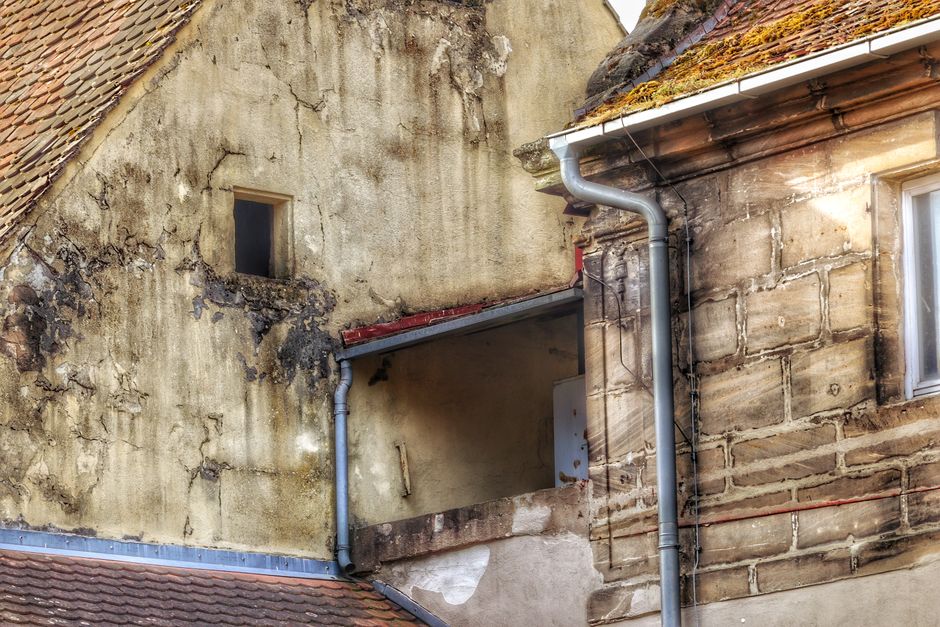
Flat roofs are the obvious offender, but they are rarely the only one. Parapets — those low walls around the roof perimeter — are where most of our diagnoses end up. They are usually built fast, capped poorly, and ignored entirely during routine maintenance. Water runs down their inner face, slips behind a failed flashing, and tracks across the slab until it finds your living room ceiling, sometimes metres from where it entered.
Terraces and verandas above habitable rooms are the next category. A terrace is a roof with furniture on it. Owners forget that, and the slab beneath it eventually reminds them.
Then there is the coast. Salt-laden air degrades sealants, eats unprotected steel reinforcement, and accelerates every failure mode you can name. A villa five hundred metres from the sea ages differently to one in the hills. The stain timeline is shorter.
Finally, the habit. The Cypriot instinct of we'll deal with it next year — understandable, expensive. Water does not pause for next year.
What it quietly becomes if you leave it alone
A stain that you ignore for one season is usually a cosmetic problem still. A stain you ignore for three is structural. The progression is dull and predictable, which is exactly why we feel the need to spell it out.
First, the stain darkens and spreads. Then the paint and plaster begin to detach — small bubbles, then sheets. Mould colonises the cavity above. In a plasterboard ceiling, the board sags and eventually fails. In a concrete slab, the reinforcement corrodes; corroded steel expands; expanded steel cracks the concrete from inside. That is spalling, and it is not repaired by paint.
The finishes downstream go too. Hardwood floors cup. Skirting boards swell and split. Built-in joinery — the kind that costs real money in a premium property — warps along the wall it was fitted against. Lighting circuits embedded in the slab become a safety question, not a maintenance one.
And then there is the part owners forget: the building's value. A documented leak history is a problem at sale. A buyer's surveyor will find what you painted over. The conversation that follows is not the one you wanted.
None of this is dramatic on any given Tuesday. It is the slow, compounding cost of treating a symptom as the whole story.
Reading the signs: warning, likely cause, where we look
The stain itself often tells us where to start. Not always, but often enough to make this table useful before a site visit.
| Warning sign on the ceiling | Likely cause | Area we inspect first |
|---|---|---|
| Brown ring directly below a flat roof or terrace | Failed roof or terrace waterproofing, blocked drain, pooled water | Roof or terrace surface, drains, parapets, upstands |
| Stain along the line where ceiling meets external wall | Parapet or wall-head failure, capping defect | Parapet capping, external wall head, flashings |
| Stain near or around a light fitting on a mid-floor ceiling | Plumbing leak in slab above, or wet room above | Bathroom or kitchen above, embedded pipework, floor waterproofing |
| Damp patch around a ceiling corner against an external wall | Facade ingress, wall waterproofing failure | External wall, render, openings, window heads |
| Persistent dampness in a ground-floor ceiling without a wet room above | Sub-structure or first-floor terrace defect, planter overflow | Terrace above, planter detailing, sub-structure drainage |
| Stain that worsens days after rain, not during | Slow migration through slab or screed; concealed retention | Roof or terrace structure, screed, drainage falls |
This is a starting framework, not a diagnosis. Two stains that look identical can have entirely different sources. That is the whole reason we do not quote remedial work without seeing the property.
How WATERPROOFED.cy resolves a ceiling water stain — properly, once
Our job is to make sure the stain you are looking at is the last one. That requires a different sequence to what most owners have been sold before. Here is how we work.
We diagnose the real source first. Before anyone talks about repair, we identify where the water is actually entering and how it is reaching the ceiling. That can mean a roof inspection, a parapet check, a moisture survey of the slab, an assessment of any wet area above, and a careful look at how the building was originally detailed. We do not patch the brown ring on the ceiling. We find the failure that caused it.
We write a clear specification. Once the source is known, we describe — in writing — exactly what needs to be done, where, in what order, and to what standard. The area affected dictates the approach, not the other way around. Whether it is a flat roof, a parapet, a terrace, a wet room above, an exposed concrete element or something in the sub-structure, we select the best-suited waterproofing approach for that situation. Different areas demand different solutions; if you want the broader picture on that, waterproofing methods explained is the longer read.
We document every defect in a report you can use with insurers. Ceiling damage is one of the more commonly insurable problems in Cyprus residential buildings, but only when properly documented. Our reports are structured to support claims — defects, causes, recommended remediation, photographs. Owners regularly tell us that the report alone was worth the visit.
We oversee vetted contractors on site. We do not hand you a specification and disappear. The contractors carrying out the work are people we have used before and will use again. We are on site to ensure the specification is followed and the detailing is correct, because the detailing is where waterproofing succeeds or fails. There is a longer piece on this in waterproofing services Cyprus: what actually stops the leak.
Every job is backed by our 10-year workmanship guarantee. Ten years is not a marketing number. It is how long we are prepared to stand behind the work, because we have specified it properly, selected the right approach for the area, and overseen the people doing it. That guarantee is the natural end of a process that started with a real diagnosis.
This is what we mean when we say properly, once. It is not a slogan. It is the order of operations.
Before you book — a quick estimate
If you want a sense of scope before a site visit, you can get an instant estimate from the homepage. A proper diagnosis still needs eyes on the property, but the estimator gives you a starting point for the conversation.
Why owners choose us for this specific problem
Most Cyprus buildings and villas are not waterproofed. They were finished, painted, and handed over with the assumption that the climate would behave. It does not. We exist because of that gap.
We work on villas, mansions, apartment buildings and complexes — not domestic odd jobs. The owners and managers we work with care about the asset behind the finishes. They want the slab protected, the report on file, and the conversation closed. They do not want a contractor coming back next spring because the patch failed.
What that looks like in practice is what we have already described: a diagnosis, a specification, documented defects, supervised execution, and a 10-year guarantee. If you want the wider view on why this matters at the property level, villa waterproofing Cyprus: what owners don't see and waterproofing specialist Cyprus: what owners actually need are the two journal pieces that go deepest on it.
We cover Limassol, Paphos, Nicosia, Larnaca, Ayia Napa and Polis. A ceiling stain is the same problem in each, but the building stock and the climate stresses differ enough that local familiarity matters. We have worked through all of it.
Frequently asked questions
Does a ceiling water stain always mean there's an active leak?
Not always active at that moment, but always active at some point — and likely to be again. Water has already passed through the slab or plasterboard to mark the surface. Even a dry stain means a path exists, and the next rain or pressure event will use it.
Why do ceiling stains often appear weeks after heavy rain in Cyprus?
Concrete slabs and screeds absorb and hold water. After a heavy first-rain event, moisture migrates slowly through the structure before reaching the underside and staining the ceiling. That delay is one reason owners misread the source and treat the wrong area.
Can I just repaint the ceiling and forget about it?
You can, and we see it constantly. The stain bleeds through within a season or two, usually larger. Worse, the moisture you painted over continues to work on the reinforcement above. Repainting hides the warning; it does not remove the cause.
Is the stain from the roof or from a pipe?
Either, and sometimes both. Top-floor ceilings usually point to the roof, parapet or terrace above. Mid-floor stains in apartment buildings often trace to plumbing in the slab or a wet room above. Diagnosis is the whole job — guessing wastes a season.
Will my insurer cover the damage from a leaking ceiling?
Often yes, but only with documentation. Insurers want a written assessment showing the defect, its cause, and the recommended remediation. We produce that report as part of our process, which is frequently what unlocks the claim.
Do you work outside Limassol?
Yes. We cover Limassol, Paphos, Nicosia, Larnaca, Ayia Napa and Polis — villas, mansions, apartment buildings and complexes island-wide. A site visit is the starting point regardless of location.
Close the loop on the stain
If there is a stain on your ceiling, the useful next step is not another coat of paint. It is a proper look at where the water is coming from, by someone who has seen it a hundred times before. Book a site visit and we will diagnose the source, document what we find, and tell you exactly what it takes to make the problem go away — backed by our 10-year workmanship guarantee. If it is easier, message us on WhatsApp and we will pick it up from there. The stain will not get smaller on its own.