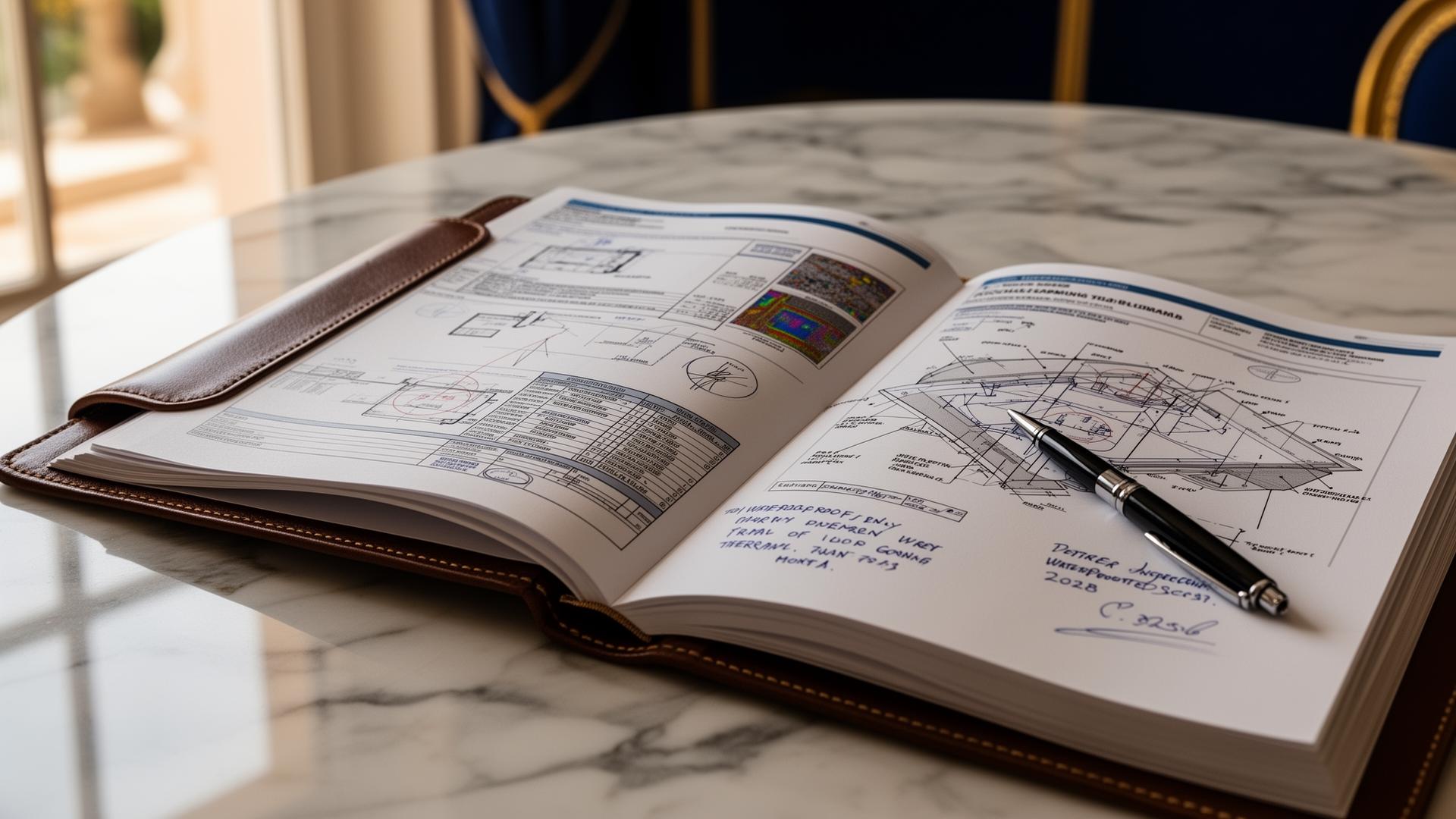
The first proper rain of the season arrives in one long, theatrical sheet, and within an hour the ceiling tells you everything summer was hiding. A faint brown halo near a downlight. A damp patch behind the curtain rail that wasn't there in September. A drip that lands, pauses, then lands again, with the patience of something that intends to stay.
That is the moment most owners search for roof leak repair in Cyprus. Not in July, when the roof is theoretically the problem. In November, when it becomes one in front of guests.
Why Cyprus roofs leak the way they do
The island builds fast, and it builds in concrete. Flat roofs, parapet walls, exposed slabs, terraces that double as roofs for the floor below — beautiful when they're done properly, unforgiving when they aren't. And most aren't.
For six or seven months a year, the sun does the work of hiding the problem. UV bakes the surface. Thermal movement opens hairline cracks no one notices because nothing is dripping. Salt air, if you're anywhere near the coast, quietly chews at anything exposed. Then the rain comes back all at once — not the gentle, conversational rain of northern Europe, but a Mediterranean downpour that wants somewhere to go in the next ninety seconds.
Water finds the cracks. Water always finds the cracks.
The leak is almost never where the stain is
This is the first thing worth understanding, and the thing most owners learn the expensive way. The ceiling stain in the master bedroom is the symptom. The actual entry point is often metres away — at a parapet detail, a poorly finished upstand, a drain outlet that was sealed by someone in a hurry, a junction between two materials that were never going to bond properly in the first place.
Water travels. It runs along the underside of a slab, along a conduit, along a beam, and surfaces wherever gravity finally lets it. By the time you see it, it has already been inside the structure for a while.
Which is why "just patch the stain" is the most common — and most pointless — instruction we hear. You can repaint a ceiling every November for the rest of your life. The leak will still be there in December.
What it quietly turns into
Left alone, a roof leak in Cyprus rarely stays a roof leak. It becomes a wall problem, then a finishes problem, then a structural one.
Moisture in a reinforced concrete slab reaches the steel. The steel corrodes. Corroded steel expands, and expanding steel cracks concrete from the inside out — the spalling you eventually see on the soffit of a balcony or the underside of an overhang. That is not a cosmetic issue. That is the building telling you it has been wet for years.
Meanwhile, the visible damage compounds. Plaster blows. Skirting lifts. Joinery swells and stops closing properly. Air-conditioning units run harder against damp internal air. Mould arrives, and once it arrives in a Cyprus winter — cool nights, closed-up rooms, humid surfaces — it does not leave on its own. The owners who call us in February have usually been losing finishes since November and didn't connect the two.
There is also the matter of paperwork. If you ever need to make a claim, or sell, or hand over to a new managing agent, an undocumented leak is a problem with no history. A documented defect, properly diagnosed and properly reported, is a problem with a paper trail — and that matters more than most owners realise until the day it matters a great deal. We've written before about the quiet failures owners miss; roofs are where most of them begin.
Why the usual repair doesn't hold
Cyprus has no shortage of people willing to go up on a roof with a bucket of something black and a brush. For a season, sometimes two, it looks like it worked. Then the sun does what the sun does, the material fatigues, the substrate moves underneath it, and you're back where you started — except now there's a layer of failed material between you and a proper diagnosis.
A roof that genuinely stops leaking is a roof where someone first understood why it was leaking. The detail at the parapet. The fall toward the outlet, or the lack of one. The crack pattern that tells you whether you're looking at thermal movement or something more serious. The interaction between the roof and the wall, which is almost always where coastal buildings fail first.
Diagnosis is the work. The application is the easy part — if, and only if, the diagnosis was honest.
How we actually resolve it
We come and look. Properly. On the roof, inside the rooms below, around the parapets, at the outlets, at every junction the original builder treated as an afterthought. We trace the leak to its real entry point, not its convenient one.
Then we choose the approach that suits that roof — its age, its substrate, its exposure, the way it moves through a Cyprus summer, the way it will be walked on or not walked on. There is no single product that fixes every Cyprus roof, and anyone telling you otherwise is selling, not solving. Our view on this is set out in more detail in our piece on waterproofing methods.
We document what we find in a report that holds up with insurers and managing agents. We oversee vetted contractors on site, because the best specification in the world fails if the hands executing it are careless at the parapet. And we do it once.
We work across Limassol, Paphos, Nicosia, Larnaca, Ayia Napa and Polis — villas, complexes, commercial buildings, the kind of properties where a recurring leak is not just an inconvenience but a steady erosion of an asset. If that sounds like yours, the broader context is here.
If the ceiling is staining now, the structure has been wet for longer than you think.
Before the next rain
The window between the first rain and the heavy winter weather is short. It is also the most useful window you'll get all year — the leak has shown itself, the roof is accessible, and the diagnosis is at its clearest.
Book a site visit, or send us a message on WhatsApp with a photo of the stain. We'll tell you, honestly, what we're looking at and what it will take to stop. Once.