On a quiet inspection in a hillside villa above Limassol last spring, the owner pointed at a faint, scalloped line running along the dining-room wall about eighty centimetres off the floor. He called it rising damp. It wasn't. The giveaway was outside — a raised concrete planter built tight against the same wall, its waterproofing turned down at the wrong angle, irrigation running twice a day for six years. The wall wasn't drinking from the ground. It was drinking from the garden. Rising damp in Cyprus is one of the most over-diagnosed and under-investigated problems we see, and that single misreading is what turns a small repair into a structural one.
Key takeaways
The short version, before the detail.
- True capillary rising damp exists, but most Cyprus cases are something else wearing its costume — lateral penetration, planter leakage, slab-edge failure, or a long-running plumbing seep.
- The tide mark, the salt bloom, the blown skirting paint — these are symptoms. The source is almost always elsewhere.
- Left alone, it eats plaster first, then joinery and electrics, then reaches the steel inside the concrete. That last stage is the expensive one.
- We diagnose the real source, write a clear specification, document defects in a report you can use with insurers, and oversee vetted contractors on site.
- Every job is backed by our 10-year workmanship guarantee, across Limassol, Paphos, Nicosia, Larnaca, Ayia Napa and Polis.
What rising damp actually is — and what it usually isn't
Capillary rising damp is groundwater drawn upward through porous building materials by surface tension. It exists. We have confirmed it in older stone properties in the villages, in basements with no damp-proof course, and in ground-floor walls where the original detailing has long since failed.
But here is the uncomfortable truth. On premium and modern Cyprus buildings — villas, mansions, apartment complexes — what gets labelled as rising damp is, in our experience, something else most of the time. A planter bed pressed against an exterior wall. A terrace above with a failed upstand. A shower waste leaking quietly into a party wall. A slab edge where the waterproofing was never returned correctly at construction. Water is patient and it is lazy. It takes the easiest route, and that route is rarely vertical.
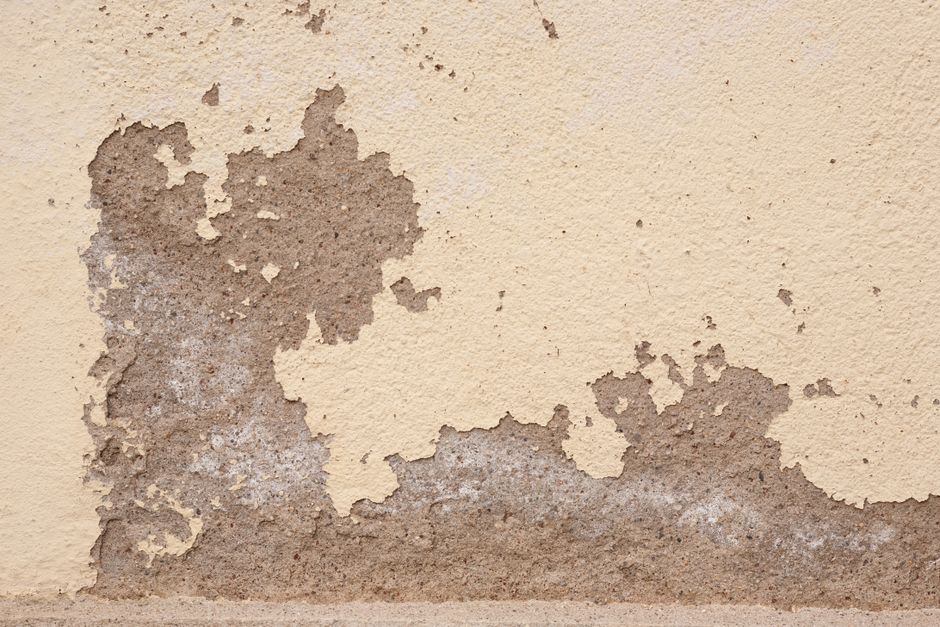
The reason the misdiagnosis sticks is that the visible signature looks identical. A horizontal tide line. White salt crystals — efflorescence — blooming through the paint. Plaster that crumbles between thumb and finger at skirting height. Owners see the pattern, search the symptom, and book the wrong trade. For a deeper look at how this pattern repeats in high-end properties, our piece on Damp and Leaks in Cyprus Villas: What's Really Going On walks through several real assessments.
Why Cyprus buildings get this wrong so consistently
Three things conspire here, and they are specific to this island.
First, the build culture. A great many Cyprus properties — including expensive ones — went up fast on bare concrete frames, with waterproofing treated as a finish rather than a system. Slab edges, terrace junctions, planter walls and ground-floor details were detailed in a hurry, or not detailed at all. The defect was built in. It just took a few winters to show.
Second, the climate's rhythm. We get long dry months where everything looks fine, then the first heavy rain of November arrives all at once and tests every weakness in a single weekend. Owners interpret the dry summer as proof the building is sound. It isn't proof. It is a pause.
Third, the coastal factor. On the south and east coasts especially, salt-laden air drives chloride into porous render and concrete year-round, accelerating corrosion of any reinforcement the water finally reaches. Inland properties in Nicosia escape the salt but get the temperature swing — hot days, cold nights, expansion, contraction, micro-cracks opening at every junction. Neither setting is forgiving.
Add one cultural factor, said with respect: the "we'll look at it next year" habit. Damp at skirting level rarely hurts on the day you notice it, so it gets parked. We have walked into properties where that decision was made eight winters in a row. By then, the wall is no longer the problem.
What it quietly turns into if you leave it
This is the part owners deserve to hear straight.
Plaster goes first. It blows, it powders, it stops holding paint. Skirtings and door frames follow — softwood swells, hardwood splits, MDF simply gives up. Electrics in the lower sockets begin tripping intermittently, then constantly. Floor finishes lift at the wall edge. Joinery in built-in wardrobes mildews from the back. Soft furnishings start to carry a smell you cannot quite place.
Then the part nobody photographs. Persistent moisture migrates into the concrete and finds the reinforcement. Steel rusts, rust expands, and expanding rust cracks concrete from the inside out. This is where a cosmetic problem becomes a structural one, and where the repair stops being a redecoration and starts being an intervention. We have written reports on apartment buildings where one ignored ground-floor wall led to balcony soffit repairs three storeys up, because the same detail was repeated at every level.
None of this is dramatic. It is slow, and it is certain.
Reading the wall: warning signs and where the source usually hides
| Warning sign on the wall | Likely real cause in Cyprus | Area we inspect first |
|---|---|---|
| Horizontal tide mark under a metre, white salt bloom | Genuine rising damp, or planter/garden bed leaking laterally | Ground-level details, adjacent planters, external render |
| Damp patch widening downward from a terrace edge | Failed terrace, veranda or balcony waterproofing above | Terraces, verandas, balconies and their upstands |
| Wet stain at the base of a basement or sub-ground wall | Slab edge failure, no functioning tanking, hydrostatic pressure | Basements, sub-structures, ground-level junctions |
| Damp confined to a bathroom-shared wall | Wet-room failure, shower tray or waste leak | Wet rooms and the back of the failing detail |
| Salt and mould around a pool surround wall | Pool shell or coping detail leakage | Swimming pools, planters, coping junctions |
| Patchy damp high on an exposed facade | Render cracking, parapet failure, exposed concrete absorption | Walls, facades, exposed concrete elements |
The pattern is consistent. The symptom on the inside is rarely above the source on the outside.
Not sure which one you're looking at?
If the wall in front of you matches more than one row in that table, that is normal — and exactly why a proper assessment matters. Get an instant estimate or book a site visit, and we will tell you which it actually is before anyone opens a bag of plaster.
How WATERPROOFED.cy resolves rising damp — properly, once
We do four things, in this order, and we do not skip steps.
We diagnose the real source. Moisture meters, thermal imaging where it helps, salt analysis where the bloom suggests it, and the part most contractors skip — walking the exterior with the same care as the interior. A damp wall inside is an investigation outside. We have found the cause in a roof outlet, a planter, a neighbour's irrigation, and once in a decorative water feature the owner had forgotten was plumbed in.
We specify the right approach for the situation. Rising damp at a true ground-floor detail is not the same problem as a failed planter wall, which is not the same problem as a basement under hydrostatic load. Each demands a different approach, and the wrong one fails fast. We choose the best-suited approach for the area and the cause — never a default product, never the easiest sell. Our piece on waterproofing methods explained walks owners through how that decision gets made.
We document the defect in a report you can use. Photographs, moisture readings, a written specification, and a clear account of what failed and why. Owners use these with insurers, with building management, with developers still inside their warranty window. The report exists whether or not you instruct the works.
We oversee vetted contractors on site. Diagnosis without supervision is a leaflet. We run the work, check the details that matter — the upstands, the laps, the transitions — and sign nothing off until it is right. This is the point most projects fall apart on, and it is the reason a waterproofing specialist exists at all.
Every job is backed by our 10-year workmanship guarantee. We work on villas, mansions, apartment buildings and complexes across Limassol, Paphos, Nicosia, Larnaca, Ayia Napa and Polis. If you want a fuller picture of how we approach high-end properties, villa waterproofing Cyprus: what owners don't see covers it in depth.
Why owners choose us over the cheaper option
Because the cheaper option is almost always the more expensive one over five years. A patch and repaint costs less on the day, and more every winter after. We have lost work to lower bids and inherited the same wall eighteen months later, worse than we first saw it. The owner paid twice. We would rather they paid once, and to someone else if they prefer — but once.
We are not the right firm for someone who wants the symptom hidden until they sell. We are the right firm for an owner who treats the building as an asset and wants it to behave like one. If that distinction matters to you, our notes on what actually stops the leak will read like common sense.
Frequently asked questions
Is rising damp actually common in Cyprus?
True capillary rising damp is less common than owners assume. In Cyprus, most cases we assess turn out to be lateral penetration from an adjacent planter, terrace, shower, or a failed slab edge — water moving sideways or downward, not up. The symptoms look identical, which is why proper diagnosis matters before anyone touches the wall.
How can I tell rising damp from a plumbing leak or condensation?
Rising damp typically stops at a consistent height — usually under a metre — and leaves a horizontal tide mark with salt bloom. Plumbing leaks are localised and often warm or wet to the touch. Condensation appears on cold surfaces, behind furniture, and in upper corners. The only reliable way to know is moisture mapping and a proper inspection, not a guess from a photo.
Will replastering fix it?
No. Replastering without addressing the source buys you a season, sometimes two. The salts already in the wall will push through new plaster, and the moisture path remains open. We have re-inspected dozens of walls that were skimmed, painted and signed off — and were failing again before the next winter.
Do I need to dig up the floor or excavate around the building?
Sometimes, but far less often than contractors suggest. The right approach depends entirely on where the water is actually entering — slab edge, planter, terrace junction, basement wall, or ground-level detail. We diagnose first, then specify the least invasive method that will hold for the long term.
Can you provide a report I can use with my insurer?
Yes. Every assessment includes a documented record of defects, photographs, moisture readings and a written specification of the works required. Owners and managers regularly use these reports for insurance claims, building-management disputes and developer warranty conversations.
How long does the work take, and is it guaranteed?
Timelines depend on the area affected and the approach specified, but most residential cases are resolved within days to a few weeks once works begin. Every job is backed by our 10-year workmanship guarantee, with vetted contractors overseen by us on site from first day to handover.
Have the wall looked at properly
If there is a tide mark on a wall in your villa, complex or building, the question is not whether to act. It is whether to act before it reaches the steel. Book a site visit and we will diagnose the real source, document what we find, and specify the right approach for it — backed by our 10-year workmanship guarantee. Prefer to start with a message? Reach us on WhatsApp. Either way, the next winter is the one that matters.