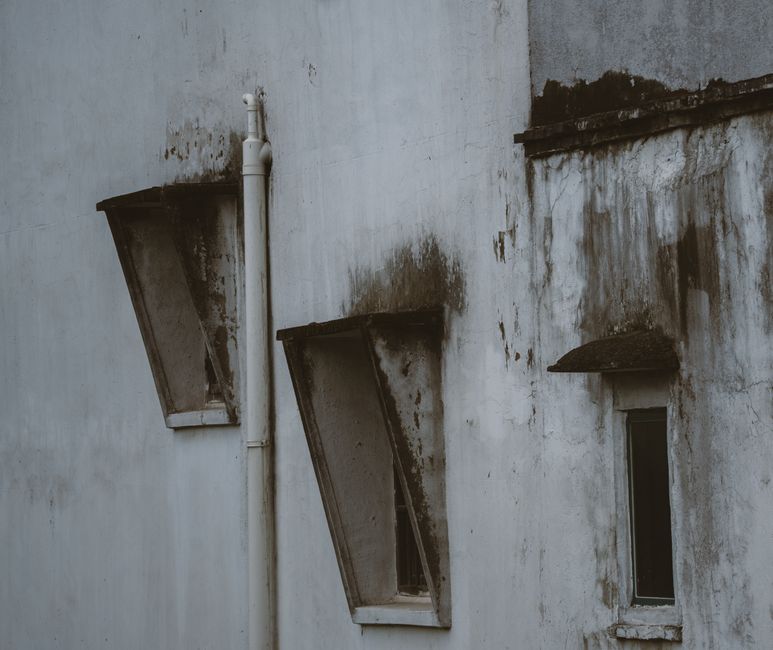
The first proper rain of the season tends to tell the truth. One long, loud November night and the wall by the stairwell darkens in a shape it never had in August — a soft, irregular bruise spreading from a hairline crack nobody had noticed. That is penetrating damp in Nicosia, and it is almost always water that has been crossing the wall sideways for far longer than the stain suggests. The fix is not paint. The fix is finding where the water is actually getting in and closing that door for good.
Key takeaways
The short version, before the detail.
- Penetrating damp is water moving horizontally through the wall — via cracks, failed render, tired pointing, porous concrete or compromised detailing — not moisture rising from the ground.
- Nicosia's long dry season followed by sudden, heavy rain is unusually hard on building envelopes; the capital's fast-built concrete stock has very little margin for error.
- Cosmetic fixes (sealing the inside, repainting, anti-mould sprays) trap the problem and let it spread.
- We diagnose the real entry point, document every defect in an insurer-ready report, specify the right approach for the area, and oversee vetted contractors on site.
- Every job is backed by our 10-year workmanship guarantee.
What penetrating damp actually is
Forget the textbook definition for a moment. In practice, penetrating damp is what happens when the outside of your building stops behaving like a barrier and starts behaving like a sponge. Rain hits the facade, finds a route — a shrinkage crack, an open mortar joint, a tired sealant bead around a window, a parapet that was never properly capped — and travels inward until gravity, capillary action or a cold internal surface gives it somewhere to stop. That stopping point is your stain.
The giveaway is the timing. It worsens with weather and it appears where the water arrives, not where the ground is. A patch above a window. A dark crescent behind a downpipe. A bloom on the inside of a parapet wall. A persistent shadow on the north or west elevation that the south face never shows. If you'd like the wider picture of how this fits with the other failure modes we see in Cypriot properties, our overview of damp and leaks in Cyprus villas is a useful companion read.
And one distinction worth making while we're here: penetrating damp comes through the wall; rising damp climbs from below it. They sometimes show up together. They are not the same problem and they do not have the same fix.
Why Nicosia is harder on walls than people think
The capital does not get the salt-laden coastal air that punishes Limassol and Larnaca, and on paper that should be an advantage. In practice, Nicosia has its own particular cruelty.
The summer is long, dry and very hot. Renders, sealants and exposed concrete bake, shrink and develop the kind of fine, almost invisible cracking that does nothing all summer and everything in winter. Then the rain arrives — not as a gentle European drizzle but as concentrated, wind-driven downpours that hammer one elevation for hours. Water that would run harmlessly off a sound facade is pushed laterally into every flaw the heat opened up.
The building stock compounds it. A great deal of Nicosia was built quickly, in bare concrete, with detailing that prioritised speed over weathering. Parapets without proper capping. Window heads without drips. Balcony slabs that double as the ceiling of the room below. Render applied thin over blockwork that was never primed. None of this is catastrophic on day one. All of it becomes a route after a decade of thermal cycling.
Add the local habit — entirely understandable — of postponing exterior work until "next year," and you have a property that quietly accumulates entry points until one wet weekend reveals all of them at once.
What it quietly turns into if you leave it
The visible stain is the least of it. Behind the paint, a wet wall is doing several things you would rather it didn't.
It is dissolving salts out of the masonry and depositing them at the drying face, which is why old damp patches develop that powdery, crystalline edge that resists every coat of paint you throw at it. It is keeping any embedded reinforcement — and in Cyprus there is always embedded reinforcement — in the one condition steel hates: damp and oxygenated. Corrosion expands the bar, the expansion cracks the concrete cover, the crack admits more water, and the failure accelerates on itself. By the time you see a rust line bleeding through render, the bar behind it has been working on the problem for years.
Inside, the consequences are more familiar and no less expensive. Blown plaster. Lifting skirtings. Black mould in the corners of bedrooms. Hardwood floors that cup along one wall. Joinery that stops closing properly. For an apartment building or complex, add the political cost: owners who can see the damage, a management committee under pressure, and insurers who want to know why the defect was not addressed when it first appeared. A documented report at the right moment changes that conversation entirely.
None of this is dramatic. That is precisely the problem. Penetrating damp rarely announces itself; it just slowly subtracts value from a serious asset.
Reading the signs: what you're seeing and where we look
| Warning sign indoors | Likely entry point outside | Area we inspect |
|---|---|---|
| Damp patch above or beside a window, worse after wind-driven rain | Failed sealant, missing drip detail, cracked render at the reveal | Walls and facades, window surrounds |
| Dark crescent on an internal wall that shares a face with a balcony | Slab edge, balcony-to-wall junction, failed waterproofing on the deck above | Terraces, verandas and balconies |
| Stain along the top of a top-floor wall | Parapet without proper capping, cracked coping, failed parapet flashing | Roofs and flat roofs, parapet detailing |
| Bloom behind or near an external downpipe | Blocked or fractured pipe, saturated wall behind a leaking joint | Walls and facades, rainwater goods |
| Persistent damp on a north or west elevation only | Porous render or exposed concrete taking the brunt of driven rain | Walls, facades and exposed concrete |
| Damp at the base of a wall that worsens after rain (not constantly) | Splash-back, failed plinth detail, ground falling toward the wall | Ground-level areas and sub-structures |
This is the diagnostic logic, simplified. In practice the path is rarely a single arrow and the obvious culprit is often innocent — which is exactly why guessing is expensive.
How WATERPROOFED.cy resolves it
We do four things, in this order, and we do not skip steps.
We diagnose the source, not the symptom. A site visit, inside and out, in the affected zones and the ones feeding them. We trace the water back to where it is actually entering the envelope, which is frequently nowhere near where it is showing. Without this step, every subsequent decision is a guess dressed up as a quote.
We document everything in a report you can use. Photographs, locations, defects, and a clear written assessment of what is failing and why. For owners this is a plan of action. For management committees it is a defensible record. For insurers it is the thing that turns a vague complaint into a covered claim.
We specify the right approach for the area. Roofs, parapets, facades, balconies, ground-level walls, basements, pools, planters, exposed concrete — each one behaves differently and each one has a properly-suited method. We choose it; we do not default to whatever the contractor happens to have on the van. We will not name systems on a public page because the right answer depends on the wall in front of us, and that is the entire point.
We oversee vetted contractors on site. The work is carried out by crews we know, to the specification we wrote, with us checking it. This is the step most projects skip and the step that decides whether the repair lasts a winter or a decade.
Every job is backed by our 10-year workmanship guarantee. We can offer it because we control the diagnosis, the specification and the execution. When any one of those is missing, nobody can honestly guarantee anything — and most don't.
Book a site visit
If damp has appeared on a wall in your Nicosia property, the useful next move is a proper look. Get an instant estimate, or book a site visit and we will come and tell you, plainly, what is happening and what it will take to resolve.
Why owners and managers choose us
We work on villas, mansions, apartment buildings and complexes across Nicosia, Limassol, Paphos, Larnaca, Ayia Napa and Polis. The properties differ; the discipline does not. We diagnose before we specify. We specify before we build. We document so you have something real in your hands — not just an invoice and a hope.
We are not the people to call for a quick smear of sealant before the next viewing. We are the people to call when you want it dealt with once, on a building you intend to keep. If the stain you're looking at started as a ceiling mark or has graduated into an active leak, those companion pieces will tell you how we approach those specific failures.
And if the source turns out to be above your head rather than beside it, roof-driven damp in Nicosia is its own particular discipline — and one we handle constantly through the winter months.
Frequently asked questions
How do I tell penetrating damp from rising damp in a Nicosia property?
Rising damp climbs from the floor and stops at a roughly even tide line, usually under a metre. Penetrating damp appears wherever water is actually getting through — mid-wall, around a window, behind a parapet, near a downpipe — and it tends to worsen during and shortly after rain. If the patch tracks the weather, it is penetrating.
Why does penetrating damp keep coming back after I have it painted over?
Because paint is not waterproofing. Sealing the inside traps the moisture and forces it to find another exit, which is why the stain returns a little further along the wall. The water is still entering somewhere on the outside, and until that entry point is diagnosed and properly addressed, every cosmetic fix is on borrowed time.
We only see it after heavy rain. Is it really urgent?
Yes. Every wetting cycle pushes salts deeper into the substrate and brings embedded reinforcement closer to corrosion. By the time damp shows reliably indoors, the wall has been wet on the inside for months. Acting before next winter is materially cheaper than acting after.
Do you work on apartment buildings and complexes, or only villas?
Both. We work on villas, mansions, apartment buildings and complexes across Nicosia and the rest of the island. For shared buildings we also produce the documented report management committees and insurers tend to ask for.
What does a site visit involve?
We inspect the affected areas inside and out, trace the likely path of the water, photograph and document every defect, and explain what we would specify and why. You receive a clear written assessment you can act on — and, if you proceed, use with your insurer.
Is the 10-year guarantee on materials or workmanship?
Workmanship. Materials carry their own manufacturer warranties; our guarantee covers the work itself for ten years. It is the reason we diagnose properly and oversee the contractors ourselves rather than handing the job off.
Have it dealt with, properly
Penetrating damp does not resolve itself and it does not stay where you first saw it. The sensible move is the early one: a proper diagnosis, a written record, the right approach for the area, and crews who are being watched. Book a site visit, or message us on WhatsApp. We will come, look properly, and tell you exactly what your building needs — and stand behind the work for ten years.