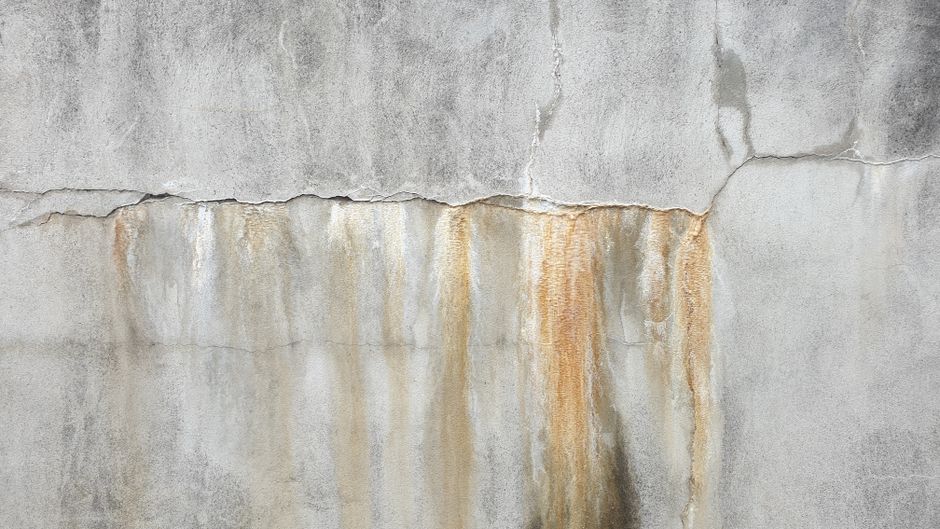
A villa above Chlorakas, a low-rise block behind the harbour, a new-build complex on the Coral Bay road — the pattern repeats. Last winter the walls were clean. This winter, a chalky white bloom is creeping out from under the render, along the base of a boundary wall, around the pool plant room, down one flank of the stairwell. The owner assumes it is dirt, or old paint, or something the cleaner missed. It is none of those. Efflorescence salt on walls in Paphos is water leaving a receipt — proof that moisture is moving through your structure and depositing dissolved salts on the surface as it evaporates. The stain is cosmetic. The pathway behind it is not.
Key takeaways
The short version, before we go deeper:
- Efflorescence is a symptom of water movement through masonry, render or concrete — never a standalone paint problem.
- Paphos conditions — salt-laden coastal air, bare-concrete construction, sudden first rains — make it particularly common here.
- Wiping, brushing or repainting treats the deposit, not the cause. It returns, and the damage progresses inward.
- The correct response is a diagnostic one: find the water source, specify the right waterproofing for the affected area, and oversee execution.
- WATERPROOFED.cy documents the defect in an insurer-ready report, oversees vetted contractors, and backs every job with a 10-year workmanship guarantee.
What efflorescence actually is
Masonry, concrete and cementitious render all contain soluble salts. On their own, sealed inside a dry wall, they cause no trouble. Introduce water — from a leaking parapet, a failed balcony upstand, rising ground moisture, a cracked render coat, a hairline in exposed concrete — and the chemistry changes. Water dissolves those salts, migrates through the substrate, and reaches the outer face. There, it evaporates and leaves the salt behind as a white, sometimes crystalline, sometimes powdery deposit.
So the bloom is not the disease. It is the fingerprint of the disease. And the fingerprint tells you two things at once: water is getting in, and the wall is porous enough for it to travel through. Both matter.
There is a related, more aggressive cousin — sub-florescence — where salts crystallise inside the substrate rather than on top of it. That is the version that quietly blows render off walls and spalls the face of concrete. By the time you see it, the surface is already lifting. If your "white staining" is accompanied by flaking render, hollow-sounding patches or crumbling edges, you are past efflorescence and into structural damage.
Why Paphos, specifically
Paphos has a particular combination of factors that push efflorescence from occasional to routine.
The coast is the obvious one. Air arriving off the sea carries chloride salts, which settle on facades, are drawn into porous render, and add to the salt load already inside the cement. Properties in Kato Paphos, Universal, Coral Bay, Peyia and along the Polis road all sit inside that airstream.
Then there is how buildings here are put together. A great many Paphos villas and blocks are fast concrete-frame construction, often with bare or lightly finished external walls, minimal parapet detailing and pool decks poured hard against habitable structures. Waterproofing, when it exists, was frequently a single coat of something optimistic applied before handover. That is not a system. It is a colour.
And then the rain. Summer here is long, dry and hot, which concentrates salts inside the fabric of the building. When the first serious November storm arrives — and it does arrive, all at once, usually overnight — water finds every unsealed joint, hairline crack and cold junction it can. It mobilises months of accumulated salt and drives it toward the outer face. By the time you notice the white streaks on the render, the pathway has already been running for weeks.
This is the same underlying problem we describe in Damp and Leaks in Cyprus Villas: What's Really Going On — a structure that was never sealed properly, being asked to behave as if it were.
What it quietly turns into if you leave it
Efflorescence is patient. It does not flood a room. It does not bring down a ceiling in a weekend. That is precisely why it is dangerous — it earns the "we'll deal with it next year" response, and next year it is worse.
Here is the progression we see, in order.
First, the render loses adhesion. Salt crystallising inside the coating pushes it away from the substrate. Hollow patches appear. Corners break off when you touch them.
Second, paint fails on cue. Any decorative coating over a wet, salt-laden wall blisters, peels or ghosts. Repainting without addressing the water buys you a season.
Third — and this is where owners stop treating it as cosmetic — the moisture reaches interior finishes. You get mould on walls in the room behind the affected facade, musty smells in wardrobes on that wall, cold patches, discoloured plaster along skirting.
Fourth, and worst, the water reaches embedded steel. Chloride-contaminated water is aggressive to concrete reinforcement. Corrosion expands the bar, cracks the concrete cover, and now you have spalling on soffits, balcony edges and column faces. That is a structural conversation, not a decorating one, and it is the point at which insurers and, in newer builds, developers become very interested in the paper trail.
A note on that trail. If your property is still inside its developer liability window, or if you are a building manager acting for owners, a documented defect matters. Photographs on a phone are not documentation. A written diagnostic report is.
Reading the wall: warning signs and where we look
Before we get to how we resolve it, a practical table. If you can see any of the following on your Paphos property, this is the area we would inspect first.
| Warning sign you can see | Likely underlying cause | Area we inspect |
|---|---|---|
| White powdery bloom on external render, worst after rain | Water penetrating facade or parapet, salts migrating out | Facade, parapet cap, window and door reveals |
| Salt streaks running down from balcony or terrace edge | Failed upstand or drainage detail above | Balcony, terrace, veranda waterproofing and falls |
| Crystalline deposit at the base of ground-floor walls | Rising moisture from ground contact or planter | Ground level, sub-structure, adjacent planters |
| White staining around pool surround or plant room | Pool shell leakage or splash-zone ingress | Swimming pool structure, wet-room waterproofing |
| Bloom on exposed concrete columns, soffits or beams | Water tracking through cracks in unprotected concrete | Exposed concrete elements, joints, cold pours |
| Salt on interior wall matching an external damp patch | Full-thickness water transfer through the wall | Facade plus interior wall, insulation cavity if present |
The pattern to notice: the deposit rarely sits where the leak enters. Water travels. A stain on a ground-floor wall can originate two storeys up at a parapet junction. This is why guessing is expensive and diagnosis is not.
How WATERPROOFED.cy resolves it
We do one thing, and we do it properly. We waterproof buildings, complexes, villas and premium properties across Cyprus — and we start by refusing to treat the symptom.
Diagnosis first. We come to the property, walk the affected areas, and identify the actual water pathway. That means looking above the stain, not just at it. Roofs, parapets, junctions, balcony upstands, planter details, pool structures, ground contact, exposed concrete, service penetrations — whichever of these the evidence points to. If the diagnosis needs moisture readings, thermal work or opening up a small area to confirm, we say so.
A written specification and defect report. You get a document that names the defect, locates it, explains what is causing the efflorescence, and specifies the waterproofing approach best suited to that specific area. This is the report owners send to insurers. It is the report building managers put in front of committees. It is what makes the decision defensible.
The right approach for the area, not a favourite product. Roofs are not balconies. Balconies are not pool surrounds. A basement wall in contact with earth is not a facade in coastal air. We select the approach that matches the substrate, the exposure and the failure mode we have diagnosed — and we do not lock ourselves to one system, because buildings do not read brochures.
Vetted contractors, supervised on site. Waterproofing fails at details — laps, upstands, terminations, penetrations. We oversee the installation so those details are done as specified, not as convenient. This is where most "waterproofed" jobs quietly go wrong. It is where ours do not.
A 10-year workmanship guarantee. Every job we complete is backed by our 10-year workmanship guarantee. It is not a marketing line. It is what the diagnostic, specification and supervision are for — so we can stand behind the outcome for a decade.
We cover Paphos, Polis, Limassol, Nicosia, Larnaca and Ayia Napa. Villas, mansions, apartment buildings and complexes. If it holds people, water or your investment, we work on it.
Book a diagnostic site visit
If salt is showing on your walls, the pathway is already open. The sooner it is diagnosed, the smaller the intervention. Book a site visit or get an instant estimate — whichever suits how you work.
The mistake most owners make first
They call a painter. The painter, reasonably, does what painters do: brush it down, apply a sealer, repaint. Six months later, the bloom is back — sometimes through the new paint, sometimes lifting it. Money spent, problem intact, and now there is an extra layer of coating trapping moisture against the substrate.
We are not against painters. We are against asking them to solve a waterproofing problem. If you would like the fuller picture on how this cycle plays out inside Cyprus properties, Water Leak Repair Paphos: Find the Source, Fix It Once and Roof Leak Repair Paphos: When the First Rain Tells the Truth walk through the same principle applied to related problems.
The rule is simple. Diagnose. Waterproof. Then, and only then, decorate.
Frequently asked questions
Is efflorescence on my Paphos wall dangerous?
The salt itself will not hurt you. What it signals will. Efflorescence means water is moving through the wall and evaporating on the surface. Left alone, that same pathway feeds render failure, corroded reinforcement and interior damp.
Can I just wash or paint over the white salt?
You can, and it will look clean for a while. But you have only removed the deposit, not the water carrying it. It returns — often through the new paint, which then blisters and detaches. The correct order is diagnose, waterproof, then redecorate.
Why does efflorescence appear after the first heavy rain in Paphos?
Summer bakes the structure dry and concentrates salts inside it. When the first serious November rain arrives, water enters through cracks, parapets, joints and untreated concrete, mobilises those salts and pushes them to the surface as it evaporates.
Does efflorescence mean my waterproofing has failed?
Usually it means there was never proper waterproofing in the first place, or the original detail has broken down. Most Cyprus buildings are not waterproofed to a serious standard. Efflorescence is often the first honest signal of that.
Do you cover villas and apartment buildings across the Paphos district?
Yes. We work on villas, mansions, apartment buildings and complexes across Paphos, Polis and the wider coast, as well as Limassol, Nicosia, Larnaca and Ayia Napa. Book a site visit and we come to the property.
Will I get something in writing I can send to my insurer?
Yes. Every diagnosis is documented in a report that identifies the defect, the affected area and the specified remedy. Owners and building managers use these routinely with insurers and, where relevant, with developers still inside a liability period.
Have it done properly, once
Efflorescence is your building being honest with you. Answer it once, correctly, and you close the pathway for good. Patch it, and you will be reading this same page next winter.
Book a site visit with WATERPROOFED.cy, or message us on WhatsApp. We will diagnose the source, specify the right waterproofing for the affected area, oversee vetted contractors on site, and stand behind the work with our 10-year workmanship guarantee. For your villa, your block, your complex — in Paphos and across Cyprus.